
Creator stories N° 19 / 23
South Africa
Rick Treweek
Co-founder and CTO, Eden
Rick Treweek is a game developer, VR developer and co-founder of Eden, a hardware and software development company. His company is the brain behind “Get Well Pals,” a 360-video edutainment platform that teaches and creates a fun immersive experience for children undergoing medical treatment worldwide. In this spotlight, Rick lets us in behind the scenes of how he got started in gaming and VR, the projects he has worked on, the limitations facing XR in Africa and his take on how the situation can be better.
Could you run us through your educational and career journey to date?
I studied a digital graphic design course and I’ve been a Unity developer for decades now - since 2006/2007. And back then there was nothing like game development for phones. It was something that we stumbled on through pure curiosity. We were a very small group of like-minded people (myself and two other South African guys), just hanging out and working on a lot of passion projects, doing web design and experimenting on mobile phones. We even developed a mobile game and for the fun of it, we put in some tech that tracked where people were playing from. So, every time someone submitted a score, we could see the country they were playing from.
Within two weeks of releasing the game, it had spread to about 140 countries around the world. That opened our eyes to see what this industry could be. Subsequently, we moved to Singapore since there was much happening on the mobile games development scene there compared to South Africa. We ended up being there for a while working on games and surrounding technologies for games. On coming back to South Africa, I got a Google Cardboard, which is a very early VR headset, and eventually made the pivot to creating VR content.
When did you make your first XR project?
The first VR test I did was around 2012-2013, with my old business partner from Break Design, a company I founded with the two other guys I mentioned earlier. We got together one weekend to create something fun and new. We took some of our old game assets from World of Rabbit (one of our former brands), put it on a Google Cardboard and in a day, we had a little working prototype where you sat inside a mech, and you could shoot evil robots. The feeling and emotion we got from that was just unbelievable and it snowballed into something much bigger.
What kind of equipment and software do you use?
I use different hardware and software packages. On the software side, the biggest programme we use is Unity. It’s a game engine and it’s free to download and use when starting. A major reason why we are so obsessed with Virtual Reality is that you don’t need to be a technical person to create content, because Virtual Reality speaks to the human side of you. If you can draw in real life, within two minutes of popping on a VR headset and figuring out how it works, you will be able to draw in Virtual Reality.
Still VR software; I used to use a package called ZBrush. That was my go-to package. I see a lot of people use all these CAD modelling packages, but they are very much on the high end in terms of cost. Whereas a lot of these VR sculpting tools are free or around $10 - $20, which is quite cheap. So I use a lot of sculpting packages to create worlds and characters, and to create assets for these experiences. They are then all tied up within Unity.
What were the challenges you faced in getting started in XR in South Africa?
A big challenge we faced was having access to the hardware we needed when we needed it. So back in the day, when the Oculus Go came out, it was available for everyone in the States, and everyone could order it in Europe. But no one would send it to South Africa.
We really had to work through strange ways before we could get the hardware here. Not only was it incredibly difficult and way more expensive, it was also a time game. So the rest of the world could have access to the hardware quite quickly. But being in South Africa, we’d have to wait a lot longer than anyone else to be able to start developing.
Furthermore, Oculus was not supported in South Africa then, so it was incredibly difficult to have any sort of engagement or conversation with relevant people to move our projects forward.
Do you face misconceptions around your work as an XR creator in Africa and how has it been engaging with a crowd that is unaware of the technology you work with?
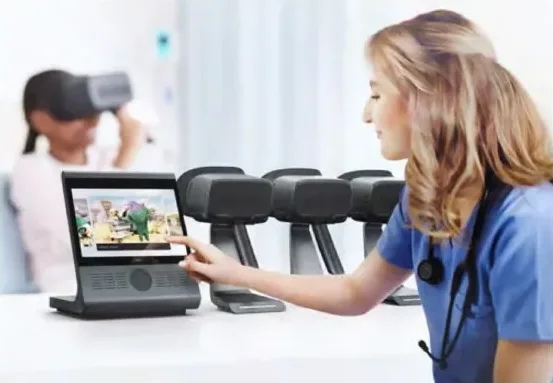
Absolutely. One of the hardest things was explaining what Virtual Reality is and what could be done with it. So, I ended up spending so much time educating clients on what they wanted, before they realised if they did actually want it or not. But now, part of Eden’s strategy is putting everything together to reduce confusion. For example, when you buy a “Get Well Pals” bundle, it has a headset with a touchscreen that lets you choose your experiences, watch everything with all the content pre-installed. You unbox it, plug it into the wall, and there it is, your VR system up and ready to use. That makes it a lot easier when we’re dealing with clients, because they can see it, they can feel it and they understand exactly what it is we are offering.
Let’s zoom in on your hardware - The Eden Snacker. Where did you get the idea to build your own hardware and what was the process around iterating and landing at the final version of the product you have now?
We organised a number of public art shows regularly and something we noticed was that people would be dressed up, and would not want to strap in to a VR headset, as well as in Africa having many hairstyles that headsets would not physically fit.
So, we decided to include a handle at the front and remove the straps of our VR headsets. Immediately, we noticed more people started engaging, because it also gave control back to the person viewing the show. By being able to hold the headsets up, if they felt slightly uncomfortable or felt like it was too much for them or anything like that, it would be very easy for them to just exit the experience.
Another issue was that some galleries were not used to charging up equipment for shows, because back then, we were using Samsung Gear VR. It was a challenge to make sure devices remained charged and ready for the duration of the shows.
To fix this, we put an induction charger inside the mask, so it wasn’t charging directly from a cable. This eliminated overheating, and as someone finished the experience and stepped away, immediately that headset would start charging. That was another innovation we introduced through our smart cradle. To charge our VR Headset as its cradled back.
Then the third one, which was a really big thing, was distribution of content. Currently, with Oculus Store and Vive, it’s a kind of closed gated community where you have to go through a lot of hoops to get your apps approved and get your content out there. We didn’t like that, and we came up with the idea of developing our Eden cloud platform. This gave us control of our content, and distribution of the content.
Our touchscreen was another innovation we made. Anyone that’s tried putting on a VR show at any event, understands the pain of awkwardly holding someone’s hand to show them how to press a button on a headset, or on a controller, because they can’t see due to the VR headset they have on.
It’s difficult to teach someone that’s never done that before and this is where our touchscreen came in. As opposed to using an awkward controller for the first time, you can just walk up to a touchscreen, scroll through it like you would on an iPad or such a device until you find a piece of content you want to play. And then you just tap it. And that then instructs the headset to load up that particular piece of content on the touchscreen, or instructs the person that’s viewing the content to go and pick up the relevant headset. Again, it just makes that process so much more human and so much easier to use.
What kind of team does it take to do the work you do, building and creating content for the hardware? And how were you able to identify the kind of skills you needed in your team?
That’s a great question. The first thing is curiosity. A lot of what we do is very new, very intuitive. It’s not something you will find on Google. Two skills we look out for in our team members is (a) programming, we have a lot of programmers and (b) curiosity, people that have a curious mind are the right people to try something new. And I think anyone that’s into any emerging tech has to have that side of their brain.
We have a super talented team at Eden, from our programmers to our unity builders, through to our content creation team and our studio team. Everyone has this inherent curiosity of the future. Most of our team members also have a background in content creation. So, coming from a traditional film and media space and now interfacing with techies, it created this perfect kind of mix, where we have the people that have great experience and content, but then we have the techies that have the experience in tech and how VR works.
It’s like a perfect marriage. Quite often, we also look for game designers, because they come from a unity background and they have an innate curiosity also.
Do you feel there is an accurate representation of the African XR creator space or is there a gap?
I think there’s an absolute gap. In South Africa, we’ve got a very tight VR community, and everyone knows how exciting it is, they know how many projects are going off. But very few of them make it into the international community. Let me cite an example.
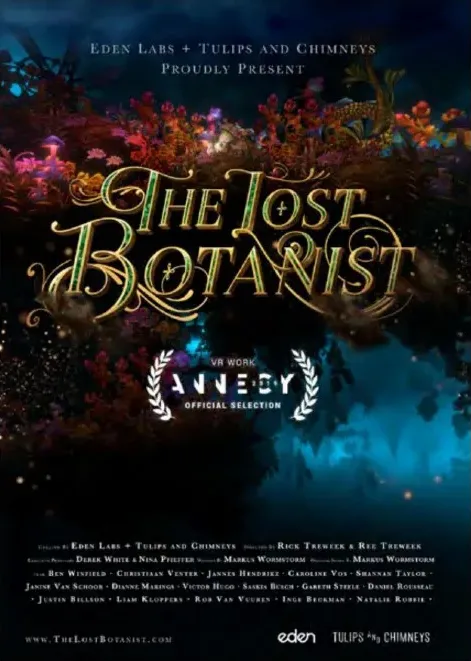
One of our first projects, the Lost Botanist, was an official selection for Annecy International Animation Film Festival in 2019. That was the first kind of VR project from Africa, coming to the stage, but I think a lot more needs to be showcased to the international community on a level playing field, because our skill set in Africa is just incredible.
I think this is also where the Metaverse is quite interesting, because when we’re hanging out in VR together every week, you’re engaging with people purely on a brain level, right? Everyone’s dressed as a funny avatar so there’s no initial judgement of anything. It doesn’t matter where you’re from, as long as you are curious and you’re excited about future development. We just need to take that concept and bring it to the realer and bigger open space.
A lot of what we do is very new, very intuitive. It’s not something you will find on Google. Two skills we look out for in our team members is (a) programming, we have a lot of programmers and (b) curiosity, people that have a curious mind are the right people to try something new
Rick Treweek
Glad that you mentioned the Metaverse in your response, what does the Metaverse mean to you?
Defining the Metaverse is a tricky topic, depending on who you ask. Speaking as a VR Unity developer, we had always referred to ourselves as the Metaverse crew before Facebook used the term. “Metaverse” is from science fiction books Snow Crash and Ready Player One.
From my own perspective, when I talk about the Metaverse it’s very much about Virtual Reality and being able to create anything you want, being able to be anything you want. Because I believe it’s the human intimacy you get from VR that creates a Metaverse.
I think everything else, for example a 2D screen, lacks a human touch. It feels like a chat room or a game. Whereas being in an environment in a Virtual Reality headset gives you that human intimacy that makes it real and intimate. That is major for me, so, when I talk about the Metaverse, I really believe that VR Social, and all that’s happening in the crypto space with NFTs and tokenomics, are fundamental, because it gives utility and confers ownership of some things. All the same, I think the term Metaverse is very messy at the moment. For me it comes from Sci-fi books, pizzas and swords.
What would you say is your most impactful or meaningful XR project so far?
Get Well Pals is definitely the most exciting and impactful. It is a children’s 360 video episodic that helps kids going through cancer treatment deal with the condition in two ways. One is through edutainment, addressing issues such as, ‘Why am I losing my hair?’, ‘Why am I tired all the time?’
The second thing is to offer distraction content that kids can immerse themselves in by just popping on headsets, and enjoying themselves in a fantasy fun environment.
We have been working with Reach for a Dream, a South African organisation that usually visits sick kids in hospitals to take them out for fun adventures outdoors. We have also been able to penetrate hospitals in the US and Europe. This has helped us see how these children’s perceptions can be changed through technology.
Everyone on the team has the amazing feeling that Get Well Pals is really making a difference, especially seeing it in action in the hospitals and seeing the reactions of kids.
Aside from Get Well Pals, the experimentation being done in the Metaverse is also incredibly exciting, because no one knows where it’s going. It’s like going into deep space, like Star Trek. The more you are in it, the more you experiment. Then you’re going to start realising what can actually be done.
Could you talk about individuals, artists or organisations you’ve collaborated or partnered with in the course of your work?
Sure. We’ve worked on different projects where we had to partner with people and organisations. For artists’ collaborations, we have worked with Mary Sibande, William Kentridge, and Wayne Barker in putting on big shows.
We have also worked with smaller artists who were able to see new technologies that they’ve never had access to before. We’ve learned so much as technologists, because they put us on our toes. We also collaborated with Tulips and Chimneys, a Cape Town animation studio, on the Lost Botanist project I mentioned earlier.
In terms of our hardware, we do the design ourselves but we partner with a studio in China for manufacturing and some other things.
We also work with a lot of freelancers who have skills that our team members do not have. Imisi 3D and Electric South are other organisations we have partnered with in the past.
How did you get funding for the projects you’ve worked on and how are you able to make profit? Also, if you got extra funding now, what would you do with it?
We are self-funded. We’ve got a runway that we’ve been developing our hardware and software on. We also have teams in the USA and Europe that are busy forming relationships with various children’s hospitals across the world.
If we got a bunch of funding now it would be used (a) on the Get Well Pals side, to create extra episodes, extra content, extra kits to go out into hospitals, and to develop additional support for other Headsets.
(b) for our Metaverse experimentations, it would be used for workshops, putting together events in the Metaverse, putting together shows that people within the collective can actually put serious time and energy into.
What other factors and resources do you think are necessary to join the XR community? Are there courses people should take?
I think the University of YouTube is always the first and foremost, like having enough curiosity to want to discover something, and knowing how to Google and knowing how to be patient to watch YouTube tutorials. I also think it’s important to be part of a community, because, as an example, Unity can be an incredibly difficult piece of software to start with, because it is so big in nature. But to make the process so much easier, every single Thursday we hold workshops and Discord sessions around very specific parts of Unity. This helps to make it digestible to people.
Once you’ve done those two or three times, then you get kind of used to it, then you do the next thing and as time goes by you’ll acquire different skill sets and you’ll realise that you’ve begun the great journey into Unity development.
I say Unity, because we have been Unity developers for so long, but Unity or Unreal, those are necessary skills to learn for sure. If you want to get started, start straightaway by downloading those two programmes, though it depends on what you want to do, as they are quite different in what they can do. And it’s free. You can download Unity and make a game immediately without having to do any sort of payment. So Unity, YouTube, and find a local community. They exist. We have the WE are VR community in South Africa, we have The Metaverse Crew (MVC), which is a lot more global, we have a very broad range of various people from across the continent there. And it’s amazing being in that group, because of the networking opportunities that it brings. Sometimes we go to these shows in VR, and it really feels like you are there with people and the other directors and other creators from various countries across the world. It’s really great to have that, not only feedback from South Africa, but from the global community as well.
What roles do you think regulators and policymakers have to play in supporting the XR industry in South Africa or on the African continent in general? What kind of regulations are you hoping to see and what kind of policies do you think would be useful for the community?
I think it is fundamental to have policymakers involved in these conversations. We need to work on data costs. This is linked to our government and certain things need to be done to give people access to cheap data. Access to the internet should be a human right, it shouldn’t be an incredibly expensive thing to do. Because having access to that knowledge is what’s going to make the biggest difference. So fundamentally, we need those decision-makers - especially from government - in the room to understand what the problems are, and to provide the infrastructure to make data more accessible.
What role do you think big tech has to play in encouraging the growth of XR and what do you want to see from them in terms of how they can engage you personally as a creator and how they can engage the continent to make sure we’re not being left behind in this new tech wave?
Big tech has a serious responsibility on their shoulders right now to be more open and to be more inclusive. I think everyone knows this. Meta needs to go beyond what it says on paper and make it real.
Big tech has to prove themselves to the communities going forward. They can’t just put out a press release, they need to put their money where their mouth is, and they need to start getting behind communities that already exist, that are already doing a lot of these developments and experimentations. Not on big tech’s terms though, because a lot of times, big tech comes in and says, “What you are doing is amazing, but you have to do it on a specific platform using these tools.” That’s not really helping anyone, they have to be honest and forthcoming if they want to grow the ecosystem.
Big tech’s got a big responsibility to show their human cards to the rest of the world now.
What are some of your predictions for the future of XR globally and in Africa? Where do you expect XR to be in the next one year, and where do you expect it to be 10 years from now? Also, what does the future look like for Eden?
Within the next year, we’ll definitely start seeing cheaper access to technology. I often refer to the progression of mobile phones in Africa. We went from these old school phones and leapfrogged into smartphones, we missed an entire generation or most of the phones in between that. I think we’re going to start seeing the same with Virtual Reality, in terms of it getting cheap enough that it is easily accessible by the people who need to access it. With the adoption of something like the Quest 2, we’re going to start seeing a lot more cheaper headsets coming out from China and that will bring prices down.
In 10 years, jeez, yeah, that is going to be sci-fi. I mean, what we see already in the Metaverse and our community and what people are developing is incredible. I think the next 10 years are going to be incredibly exciting. I think there’s a huge responsibility for people that are already in the tech game like our Metaverse crew, to be there to help guide the Metaverse in a way that we think is right. Many decision-makers have probably never even been in the Metaverse, but because it’s on their mandate, a lot of their ideas might make sense on paper, but fundamentally might not make sense just because they haven’t actually experienced the Metaverse. I think there’s a huge responsibility for people that have been in the game for a while to help guide this.
At Eden, we’re incredibly excited about the future. Our mission is to put as many smiles on as many kids’ faces in as many hospitals on the planet as possible. I think this first phase of getting people to adopt the technology, getting people that don’t understand the power of VR to at least try it, is the trickiest one. But as soon as we have our systems in more hospitals, then we really start seeing the benefits of it. We will just see an absolute uptake and that will enable us to expand Get Well Pals into the universe and continue to make amazing, happy, incredible educational content that really helps change lives across the world.
From the Africa XR Report 2022, pages 254–265. Open the PDF at this interview.