
Creator stories N° 16 / 23
Uganda
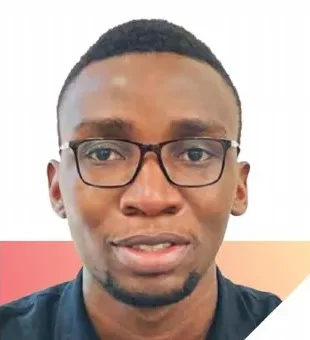
Mike Nsubuga
ACE Lab, Makerere University
Mike Nsubuga is an IT and Software Development Professional at the African Center of Excellence (ACE) in Bioinformatics & Data-Intensive Sciences. ACE was established by the Infectious Diseases Institute at Makerere University in Uganda. His work involves optimising medical applications development through VR and AR. In this spotlight, Mike takes us through his journey as a software developer working with XR.
How did you start your journey into XR?
I have always liked computers, I think since childhood, the best things that have always sparked my interest have been computer related. After my first degree in computing at Makerere, I embarked on a journey to explore more in computing and how I could use it to address challenges in different sectors. I got accepted for an internship as a software developer with a UK-based company called Statistics for Sustainable Development (Stats4SD) which expanded my knowledge in the field. While doing that, I also enrolled at The Infectious Diseases Institute, where I realised an opportunity to use my tech skills in the Health space. So I joined, with the motivation to use my computing skills to fill that gap.
In my degree curriculum at the College of Computing, there wasn’t something specific that taught me about XR. But I was able to dig deep into XR online speciality courses at the ACE. The ACE has a VR lab and so it was a good avenue for me to learn new skills. I got some of the resources from Udemy, where I enrolled in a couple of VR development courses. I remember my first one was in Web VR as it sparked my interest due to my previous experiences making Web applications. I enrolled in a React VR course hoping it would help me build interactive VR experiences accessible from a web browser. I already had some experience doing Web applications using the same sister framework, React so I was able to build something. I continued on with more resources that I could get my hands on like Unity VR development, among others.
What are the challenges you face?
Speaking for the VR lab where I am based, at the moment, one of our biggest has been expertise. Not so many people are skilled in this area. During some of the projects we’ve undertaken, the people have had to go through special training before doing the projects.
Funding is another challenge that affects our turnaround time in bringing some ideas to fruition. Luckily, I have access to all the latest VR equipment from my lab so that hasn’t been a challenge, though sometimes it can prove to be one since most of these are quite expensive.
There are very few XR communities in the country and online, making access to XR technical support very hard. This has hindered some of my work, I remember in some of the situations, I have had to reach out to the actual creators of Unity for technical support, and I am happy they have helped whenever they had the chance.
Tell us about the equipment you use?
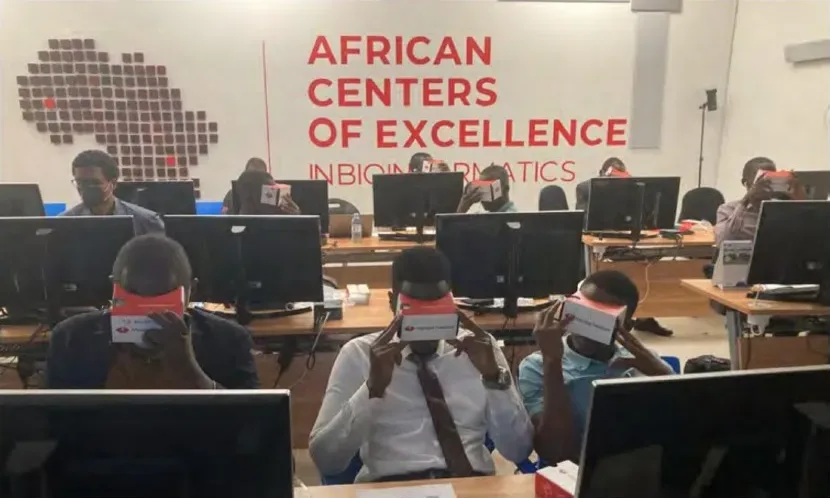
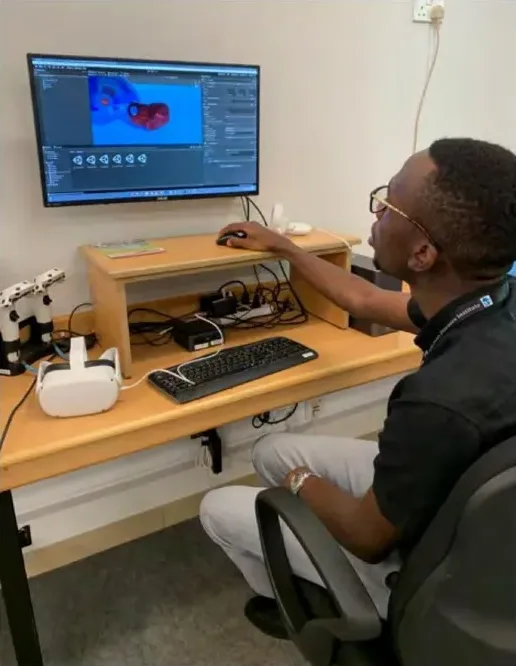
The lab where I work is fully stocked all thanks to the NIH NIAID Office of Cyber Infrastructure and Computational Biology (OCICB), which donated this equipment to us. The equipment ranges from devices that enable VR to happen, to all other VR-related accessories.
It’s a set of components. The most important one, I think, is the headsets themselves. We work with the HTC Vive Pro and the Oculus Quest 2, there’s also the NVIDIA 2080 Ti X cards that support high graphics processing and development. We also have a GoPro Max 360 camera that is handy for creating 360 video content.
Which of your projects would you consider the most impactful or significant?
We worked on a COVID-19 project that started at the end of 2020 and ran through 2021. From the needs assessment carried out, there is an urgent need to use Virtual Reality in education through training. This is due to the nature of Virtual Reality and what it offers to aid students’ needs. VR makes learning engaging and thus, enhances learning retention.
We thought of using Virtual Reality for training in the thick of the pandemic. Our healthcare workers in Uganda were overwhelmed by COVID-19 cases. We could train them to be competent in doing their job without exposing them to risks associated with COVID-19. I led the development of an XR platform (SOMA), which has now been recently published in the BMC Medical Education Journal.
So we sat down with a team - of creatives, content creators, animators, software developers, medical doctors, and the trainers themselves - and we defined a project where we could create content that medical healthcare workers could use to manage and handle patients in a COVID-19 setting, like a hospital. That was the idea behind the project.
We were able to complete the development of what we had defined, and we developed our minimum viable product. The platform was divided into 3 main parts, the first of which had content for the theory and basics. Here they learned the basics of COVID-19 and the structure of the virus which was delivered through a virtual experience.
The second part consisted of 360 videos. We made recordings in 360 and then developed a platform that holds recordings in an interactive experience.
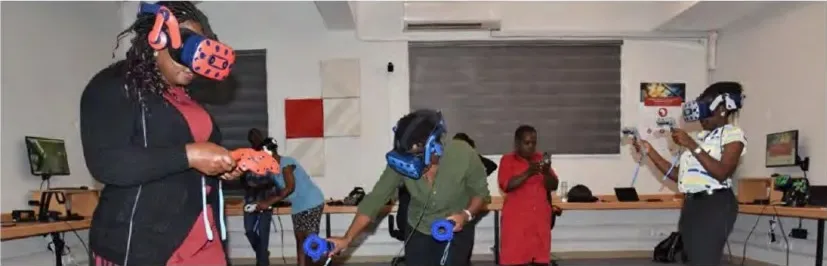
The third part consisted of immersive VR, here we went an extra mile to develop something that involved them feeling and touching different things in the environment, practising donnin, and doffing of PPE (Personal Protective Equipment). This was an immersive experience that assessed them as they did the training.
We enrolled some front-line healthcare workers onto the platform, from all around the country to try this out. The results were amazing, they really liked being in the environment compared to the classroom-setting they were used to. According to the assessment, the concepts were grasped much better and this was evidence that Virtual Reality technology can be used effectively for this type of training.
We thought of using Virtual Reality for training in the thick of the pandemic. Our healthcare workers in Uganda were overwhelmed by COVID-19 cases. We could train them to be competent in doing their job without exposing them to risks associated with COVID-19. I led the development of an XR platform (SOMA), which has now been recently published in the BMC Medical Education Journal
Mike Nsubuga
Any particular partnerships and collaborations you would like to mention?
NIH NIAID Office of Cyber Infrastructure and Computational Biology (OCICB) for the technical support and guidance they’ve given us right from the beginning, and for making XR possible in the country. RENU for the internet connectivity at the lab, and Enduvo, a VR authoring platform enabling you to create VR content as easy as it is creating a PowerPoint presentation!
What do you think about the level of support in the African XR scene?
I think there is a need for an African XR community. As much as these technologies are coming, you must appreciate that Africa is different. I feel like if we have more African-based communities, they may be able to address some of the African-based challenges. For example, it’s common in Africa to have some challenges that may seem small to others, say like power and internet connectivity issues; having thoughts shared within the African XR community, XR spaces may help in how we can all collectively solve these issues.
What roles do you think policymakers and regulators have to play in supporting the XR industry in Africa? What kind of policies do you think would be helpful for the community?
I’m happy with having policies in place that are good for the XR community. I believe that as more people adopt VR technology, the risks to privacy and security will become increasingly important.
So at the forefront of mitigating these risks are the VR designers and developers who navigate the field using their own moral compasses. So I believe that if policymakers can define these policies and the ethics we can follow, it would be good. It is important to have legislation that ensures people’s safety with XR and Transparency about the data collected by XR applications.
Having these in place will undoubtedly reduce people’s worries regarding XR and increase uptake of the technology.
How have you been able to fund your projects so far?
Most of it has been through grant funding. In the past we’ve received grant funding from Makerere University, we also have collaborations with NIH NIAID Office of Cyber Infrastructure and Computational Biology (OCICB) which provides us equipment and structural support. We also have lots of collaborations within the Ugandan space.
What are your thoughts on the future of XR in Africa?
I’m very confident about what the future holds based on what the past has shown and how we’ve improved. If someone is reading this about XR and they are passionate about it, regardless of the challenges they may face, I would tell them not to give up. It’s a promising journey that I would advise people to take on and explore at the moment. I believe there are lots of opportunities in Africa for using XR to solve existing challenges in education, entertainment and much more.
From the Africa XR Report 2022, pages 230–235. Open the PDF at this interview.