
Creator stories N° 14 / 23
Republic of Benin
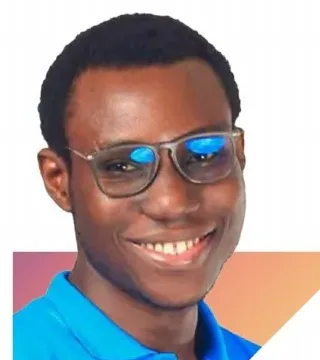
Marie-Parisius Houessou
Founder and Manager, Dreamxr
Marie-Parisius is a full stack software developer, scrum master and agile management consultant. He’s also the co-founder of DreamXR, a Mixed Reality startup, based in Benin Republic. In this spotlight, he shares his journey into the XR industry, his achievements, and his hope for the future of XR in Benin Republic.
How did your journey in XR begin?
I started hearing about some technology called computer vision and at the time this meant nothing to me. Then I learnt about VR when I was learning computer vision. I love manga and anime. One of my favourites is called Sword Art Online. In it there is a VR experience where people just had to lay on the bed, wear a VR headset, and by saying the word links, they entered into a VR world. No controllers are required there, the brain does all the work. The immersion of Sword Art Online was a total full immersion. I began to ask myself if I could create an online game like that, and so I started learning VR. The technology was very interesting. You just have to wear a Google Cardboard and have a smartphone that has the gyroscopic sensor, then you can have a VR experience.
But very rapidly, VR started annoying me because I had to wear a VR headset and they were very expensive at the time. Unlike today, where we have the Oculus Quest - which is still quite expensive. The VR headsets were not in Benin yet, so I ordered my first VR headsets from France through a friend.
I could create some games and play with friends who would test them using my cardboard and cell phone. But the impact of 3D reality in front of your eyes did not leave me, so I started looking for other programs to use. In the process, I came across AR. AR is very interesting. I used to say that with VR, you can go anywhere but with AR, you can make anywhere come to you. You don’t have to own a bunch of materials to test an Augmented Reality experience. You don’t have to buy a computer that has loads of high specifications. With the aid of Unity, I started developing AR experiences with Vuforia.
What kind of content does DreamXR create?
DreamXR was started in 2017 and I was a third year student at the time. The company was initially called IRL Laboratory (In Real Life). Our goal was to bring a lot of what we see in sci-fi movies and games to reality. We started with some applications that allowed you to send greeting cards by adding an AR experience.
DreamXR is a new way of seeing our dream, which is to make XR possible globally. Today, we do a lot of our jobs on webAR and webVR. We had to switch because too many people complained of having difficulties downloading large files, which was an issue we had when using Unity and Vuforia to build apps. So we looked up some webAR things, webXR, web GL and stuff like ARGS, and started looking for a way to make a better experience. Since most people had browsers, they didn’t need to install an app, but could access a link to an Augmented Reality experience and even Web VR experience.
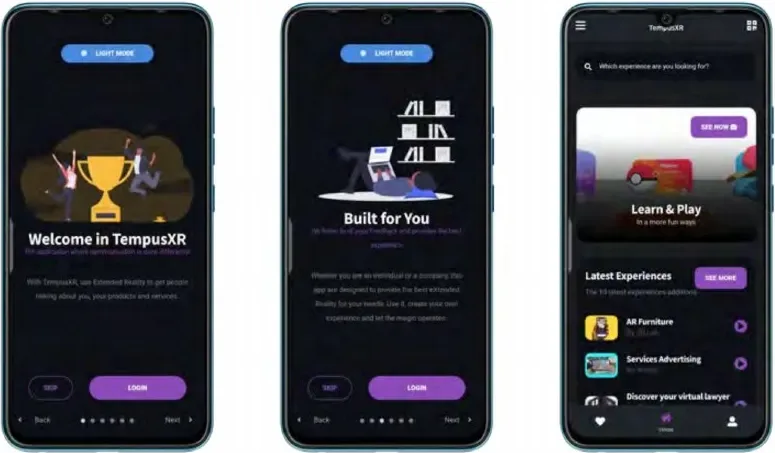
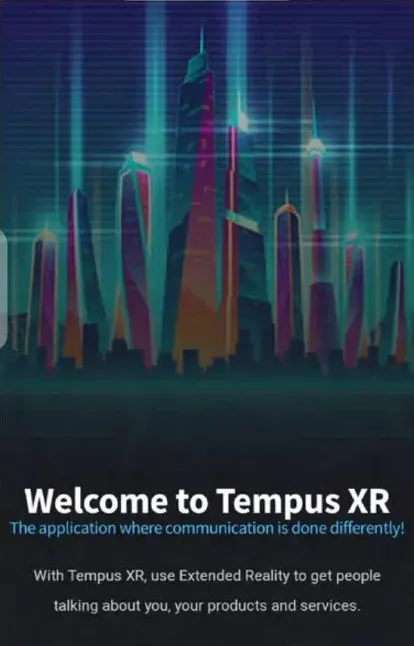
Now, we are developing a platform called TempusXR. Tempus in Latin means ‘moment’. So you can develop or create your Augmented Reality experience to last for a moment. It’s like a WordPress of Augmented Reality.
The Tempus app has two parts. We have a Tempus studio where people create their Augmented Reality experience. We have friends, some particular people, some big companies that are using them today. And we have the mobile app, which is in fact a web app. We convert in PWA, (progressive web apps), so people can have the two applications on the web and create their experience. Then they can share them in the TempusXR mobile app, and it will be more accessible to customers to get links to see your experience. That’s what we are doing today.
We are also proposing an API to help developers who want to use our solution for free without the need of the studio pads. But all the experiences are getting pushed to the mobile app.
What’s the size of your team?
We have eight people fully working at DreamXR. We have a full stack software developer, three web developers, two people who do 3D modelling and animation, and two mobile developers. So, to keep the balance, we have a project designer.
How do you recruit talent with the right skill set?
It’s very difficult. Until 2018, I can say I was the only one doing XR developments in Benin. When I was at university, I met a young boy who was very interested in XR. I started coaching him and then we became a team of three, my brother included. After that, it was difficult to get people to join us. We did all the work by ourselves.
I decided to teach those who were interested in XR but didnt know how to get started. I later recruited some who were interested in working with us. Training your staff is very important if you want to get the best out of them.
How would you describe people’s reactions to XR and what you do?
In a country like Nigeria, XR might not have as low interest as it does in Benin. So you have to keep explaining to people what XR is. Because when you say Virtual Reality, people just see games. They don’t see all the other things you can offer and I have to try very hard to make people who surround me everyday understand what Augmented and Virtual Reality are. In Africa for instance, and especially in Benin, I see that XR requires a little teaching and discovering.
How do you think people perceive the Metaverse?
For them the concept of the Metaverse is what they see online. They see it as a VR world where you need to put the headset on your head to enter into the Metaverse, enter the virtual world and have some interaction. They are excited about having meetings in Virtual Reality using avatars and so on.
They see the Metaverse like a market where they have to make the enterprise known to other people by selling virtual goods like NFT’s. They also see it like, just a VR world where people can get connected and play games. Everyone doesn’t understand what the Metaverse really is. Even I prefer to call it the Omniverse because it’s not just a VR World. I think the Metaverse will grow, and by growing, we’ll start to interact with 3D objects in our real life using AR glasses or a digital lens which you can put directly on your eyes. The Metaverse will become more than a VR experience.
What equipment does your team use in creating experiences?
We use smartphones, Blender for 3D modelling and Cinema 4D. We mostly use Eframe and 3ds Max to create the 3D environments in the world. But to embed them in AR, we developed our own SDK which we call Tempus SDK to get the work done. So since we use WebAR and WebVR, our main technology here is HTML, CSS and JavaScript. We use Node Js and Vue, depending on the project at hand. We also have a VR headset and Google Cardboard.
In a country like Nigeria, XR might not have as low interest as it does in Benin. So you have to keep explaining to people what XR is. Because when you say Virtual Reality, people just see games. They don’t see all the other things you can offer and I have to try very hard to make people who surround me everyday understand what Augmented and Virtual Reality are. In Africa for instance, and especially in Benin, I see that XR requires a little teaching and discovering.
Marie-Parisius Houessou
Tell us about the project you’re working on?
Two years ago, we came up with the idea of making prototype glasses. It was a vision in our head and we drew models. We want to put our Augmented Reality experience in the eyes of people. The prototype will embed a camera. We are looking for the camera which has the highest resolution and is small enough to be put on glasses. The glasses won’t be big, so people can wear them conveniently and it won’t feel heavy on their faces. So we delved into technologies like Arduino and Raspberry. We started with Arduino Nano, and we will add the Raspberry VPS, the C version with Bluetooth and Wi-Fi.
We are dreaming about a fully independent Augmented Reality pair of glasses that can fit the size of the natural glasses you wear to cover your eyes from the sun or use for medical reasons. We want people who already wear glasses to switch from the Non-Augmented Reality glasses to ours without losing the medical prescription they have on their actual glasses. We want the prototype to be done before the end of this year, but right now we don’t know how it will go.
What would you say are some of the biggest challenges you have faced?
The biggest challenge the company faces right now is getting good material. At the moment, we don’t have the financial resources to buy a good computer with good memory, good graphics card and good RAM.
We have a few customers who already use our services, but they don’t pay so well. We have to make compromises because we want our team to get accepted. We also want some big names to use our team before launching the mobile app for the people in Benin. So, finance is a very big challenge for us.
What are some of your thoughts on regulations and policies that governments and policymakers can make to support the growth of XR in Benin Republic?
That’s a very tricky question. The government here in Benin has been doing a lot in order to let small startups do technological things, Artificial Intelligence and Internet security amongst others.
So, for XR, there might be a need for them to create a great Virtual Reality centre in the big town here in Benin to enable people to experience it.
What about big tech companies? Is there any way you think they can also engage you as an African XR creator?
They have a lot of things they can do. They see Africa like the new El-Dorado of technology, because we have many things we can do with our technology here in Africa to help solve people’s everyday issues.
Maybe they go into partnerships with some XR companies here in Africa. We can help them make the platform more affordable by creating some developer certificates.
What has been your source of funding?
It’s all been self-funded.
If you were able to get access to funding, what would you do with it?
First, would be to get a bigger place for our team to do more things. The second would be to get the tools we need to work in order to deliver faster. And we will create a VR centre near our new office to get people to discover what VR and AR are, though it will be a paid experience.
How would you describe your experience building XR so far?
Technology is evolving every day, in web AR and web VR, and even in native AR and native VR. So working in this field and developing experiences for this field is very interesting, because you have to re-adapt yourself every day. I don’t love when things are status quo. I love things that move every day.
From the Africa XR Report 2022, pages 218–223. Open the PDF at this interview.