
Creator stories N° 11 / 23
Ghana
Kabiru Seidu
Co-Founder & CEO, NubianVR
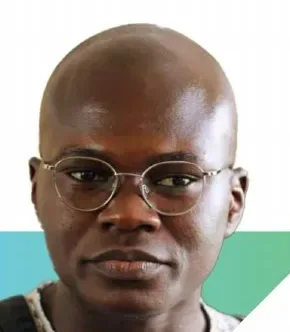
Kabiru Seidu is the Co-founder and Innovation Leader of an interactive products and games company, NubianVR based in Accra, Ghana. He’s passionate about the education sector and all the ways digital learning can be used to develop learning and interactivity. He is also the Co-founder and Programs Director of Nubian Foundation, which works closely with several government agencies and INGOs like UNICEF to carry out research that is focused on understanding how VR can be used to improve the learning experience. In this spotlight, Kabiru shares how he became an advocate for XR and the potential it has for innovation in education and the future.
Tell us how your journey into XR started?
It started back in my former neighbourhood in Kaduna, Nigeria. My mom was one of the first people to set up an Internet café. It gave me an early start in computer education and an upper hand. I used to make prints of the diagram of the circulatory system or whatever topic that the teacher was teaching in school and take them to class.
I studied Computer Science at Ashesi University, where I got actively involved with projects related to education. I worked with a team that was running an adult literacy foundation in villages close to the school and was excited about teaching the elderly members of the community. At that time, most of the work we were doing was low-tech and I was a little bit dissatisfied with the methods we were using to engage them.
After graduating from university, I was trying to figure out my career path and decided to stay on to work as a faculty intern. I had a very close friend, Jonathan Dotse, who is a filmmaker. He had gotten excited about Google Cardboard, but there was no access to it here. He had to make a Google Cardboard by himself using the open-source design. I was just coming out of a class when a sleep-deprived Jonathan showed me the completed headset. Before that day, my first knowledge of Virtual Reality (VR) was from a YouTube creator called Jason Silver around 2014, who got me super excited about it. I had done a bit of research into it, and considered how it could be used in the education sector. But before Jonathan gave me the headset, I had never experienced VR before.
I went to one of the bathrooms at the university, and had a full cinematic experience. I had never encountered anything like it, and it got me committed to exploring the technology.
Our early works in NubianVR were largely around designing content to use on our prototype Google Cardboard. That was in 2015 and there weren’t full 360 cameras. So we rigged a setup with two Kodak SP360s and stuck them together to record simultaneously.
Later we stitched the videos together to form a complete 360 video. That was how we were able to produce a short story called Pandora, which was a tour of Accra in 360 from a very interesting character. The first demo was at the Chale Wote Street Festival here in Accra. I believe it was the first 360 film made on the continent and my entry into VR.
Have you branched out to other XR spaces apart from the VR space?
VR is still in its nascent stage, and the equipment is expensive. As a result, we’ve had to involve ourselves in other aspects of interactive technology. This is okay because we don’t see VR in isolation. VR is a continuum of other technologies and doesn’t exist alone. So we embrace the possibilities to venture into other spaces like AR and MR. Our work covers developmental Virtual Reality applications and Augmented Reality applications, but our primary work is interactive games on mobile. Plus, from a product point of view, we’ve had to accommodate the reality that VR solutions are hard to market on this side of the world.
We’ve also worked with other forms of technology in creating web games. Presently, we’re working with UNICEF and the Ministry of Education here in Ghana to digitise new lesson material they created to teach schools about online safety and digital literacy. The content will be utilised as mobile interactive games, instead of VR, because of accessibility. We will eventually build content on the VR platform when the equipment becomes cheaper.
How do you find people with the technical skills to build this technology?
In the early days of NubianVR, finding the right people was our biggest challenge. Whenever we had a project, we went through a line of developers who we thought had the skills, but we were eventually disappointed by their work. Or if we put out a call for Unity developers, we’d probably get one or two people.
But we recently put out a call for developers, and wow, we got an overwhelming amount of responses. I found it very encouraging, and it showed that there are people committed to gaining knowledge of the technology. In NubianVR, we have a very fascinating, technical lead. His name is Andy Cushing. When we found him, he had little or no experience in VR. Andy’s background is in traditional web development. He’s a gamer at heart and has a portfolio of his games. It was a dream come true for him to find a company that was ready to pay him to make games and VR applications. My particular skills are largely around product development and product management, so I work closely with Andy. Together we resolve any technical issues of the products or ideas that I conceive in my head.
Most developers were either not motivated enough to learn about the technology, or did not have the relevant skill set that made it easy for them to transition into VR development. So finding talents was a challenge for us.
How has the content you create evolved?
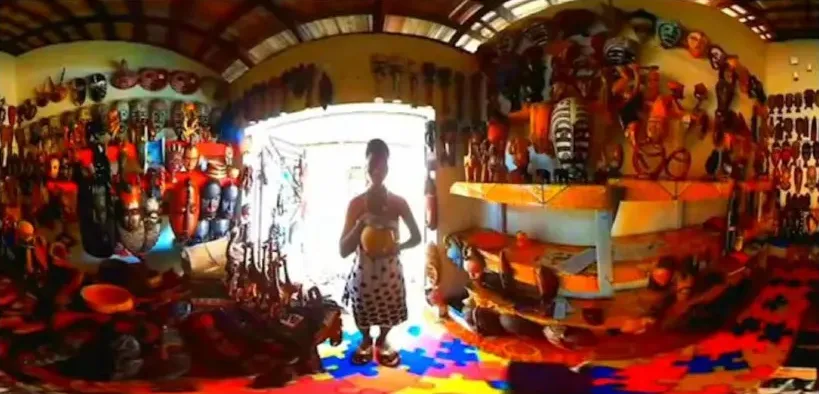
In the early days, most of our content was 360 videos. Pandora was the first. We also did a fun exhibition in Senegal and the theme was an alternate reality. We created a VR 360 experience essentially made with Unity. Then we went ahead to create some more 360 films.
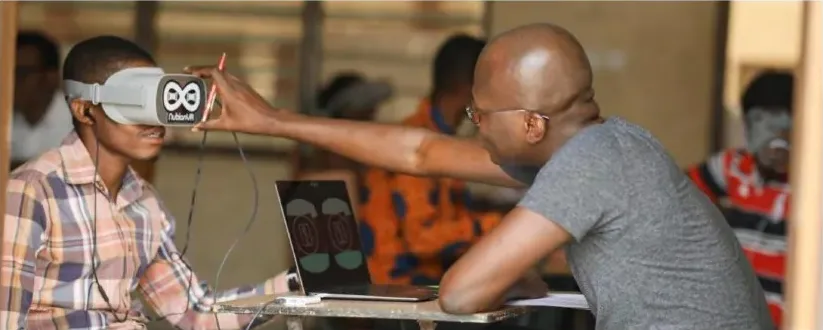
Between 2015 and 2017 there was a lot of experimentation. We were doing a bit of 360 film and creating a few interactive VR applications. Now, our primary focus is to hold the hands of organisations and ask them, ‘How can we help you take your courses online?’ With COVID, lots of them have been able to implement some kind of online training programs. So our value proposition to organisations beyond the school community is to help them digitise their employee handbooks and training materials into mini-games. Based on that, we would be able to move them gradually towards appreciating the value of interactive technology and guide them towards understanding the XR experience.
How has the experience with organisations that are adopting the XR technology been?
In reaching out to organisations it has been a mixed experience. Let’s say in the mining space, they see the value VR can offer if we use it to update their training.
Unfortunately, VR solutions are capital intensive and require a huge financial commitment. Most organisations are not willing to pay the extra money, but they want to take their training to the next level, so we make the video for them. That has been the reception so far, particularly for VR.
However, there has been a higher interest in interactive technologies like mobile apps and web apps. Although it’s not what we initially set out to do, it is the level that we are at now.
What projects have you done that you have been significantly proud of?
Just for context, I had little to no experience with VR. I was working with a team that was managing a project funded by the Ford Foundation. The objective was to get students in Ashesi to start projects that would have an impact on the university’s community. Most of the projects in my portfolio were in the educational space, and that was where I was most interested.
In 2019, when we secured the UNICEF Innovation Fund grant, we set out to build an open-source educational platform that would be able to make it easier for anybody who was going into content creation in VR to find the relevant tools that they needed.
The project is recognized as a digital public good and I feel proud of it. The work we’ve done is publicly available and people have the opportunity to access it. Unlike when we started building VR content, and it was daunting to access that kind of knowledge. We have put out work that essentially helps alleviate the challenge, so it’s something that we are proud of.
Then there are a couple of other in-house projects that we haven’t made public. They are arcade and adventure games that require a lot of resources. Our approach to building games is to brainstorm on how we can build prototypes to demonstrate the full game. or a vertical slice, as they call it in the industry. Despite these games still being in development, I’m proud of them, largely because they keep our lights on. We have decided to diversify to other fields that are much more on the path to VR, although they are not necessarily VR technology.
Can you tell us how you were able to get the UNICEF Grant and what the experience was like?
I think the experience made us realise that we were doing serious work, and people around the world recognized it. We had been taking it seriously, but it felt like we were just dreaming. We didn’t think we would be able to get to the final destination we had in our heads. So when UNICEF reached out to us in 2017 and encouraged us to apply for the Innovation Fund it was very serious. They said they had seen our work and were interested in us. We were also told that the funding was up to $100,000, enough to cover the cost of building our VR solution. The catch was that they wanted it to be open-sourced. For us, it was not a big deal because our work relied on open-source technology too. Since we were able to benefit from it, we wanted to contribute to giving back to the community. When the program started, we agreed that we would build a lesson creator that is easy for anybody that wants to create VR lessons to access. If they had a video that they wanted to insert into their lesson, we made it easy for them to do that. If they wanted to create a 360 video or any interactive component as a part of their lesson, the lesson creator was able to help them with it.
I have to admit that the early days of the project were emotionally gruelling and a bit daunting development-wise. I mentioned how difficult it was to find development talents. We had hired a few developers for a while but most of them transitioned into other roles. Before we completed the project, we changed about three developers because we realised that the skill set was unnecessary. The most painful experience was when we had to change our code-base, but ultimately it resulted in us finding the talents we were looking for, so not a bad thing.
What equipment and software did you and our team use to build the experience that you work on?
We used a range of them. So, for the software, we use Unreal Engine for some of the experiences. However, we use Unity Game Engine the most. Also, when we started, we flirted with Web VR, but the scope of what we needed to do was technical and we weren’t getting the results we needed on the web. It was a hard decision for us to transition to Unity, but it was necessary if we wanted to go down the open-source web routes.
Our hardware has evolved. Initially, when we started, it was with Google Cardboards. We didn’t have the budget to get the Oculus DK2, so we used the next best thing which was, the Samsung Gear VR. Eventually, we transitioned to Oculus Go. The lesson creator for UNICEF was primarily designed with the Oculus Go. But the Go is no longer supported by Oculus, that’s why we are working towards transitioning most of our codebase from Go to Quest. We are relying on Quest for our VR solution and also AR, because we build mobile and web games. Lastly, we use smartphones.
The technology is growing as the years roll by, how has it been in terms of accessibility to equipment?
The Quest is a game-changer for VR. The promise of VR in a device that costs around $300 is awesome. Looking back at when we started, I think that accessibility has greatly improved.
In 2015, we had to hack together some kind of VR headset which was suboptimal until we got the Gear VR. By the way, you had to use a Samsung phone with the Gear VR and that was around $1,000. The Gear VR holder was an additional $200 or so. If you didn’t want to go that route, you would be spending $1000 on getting an Oculus-ready PC, and another $600 to $700 on getting an Oculus DK2. From about $1200 or $1800 when we first started to $300 or $400, the trajectory speaks for itself. We want to see VR equipment become more accessible and mainstream. Just like how in 2010 there were under 200 million people in the world using smartphones, but ten years later that number has grown to about 2.5 to 4 billion people.
We want to see VR equipment become more accessible and mainstream. Just like how in 2010 there were under 200 million people in the world using smartphones, but ten years later that number has grown to about 2.5 to 4 billion people.
Kabiru Seidu
What are the challenges you have faced as an XR creator?
There are a lot of challenges and I’d like to address them from various angles. From a human capital point of view, web development talents have flooded the markets.
If you go looking for XR creators, what you’ll get is an overwhelming number of web developers, full-stack developers, front and back-end developers. And many of them have not honed their skills so that they can be relevant in the XR space. There’s still a limited amount of talent in the market, but it is better than before.
From a product point of view, VR is very much in its early stages. It is a fact that building VR technology is very expensive and most VR companies are after a product-market fit. However, it is important to acknowledge that there are a lot of high-risk investments in this space, because everybody is still learning and carrying out experiments.
Even keeping a team of creators is expensive, and you require both technical and creative skills. It will be best if people have the right mindset and are more accommodative of the technology.
Concerning the work that you do, have there been misconceptions from people that are not familiar with the industry?
One of the misconceptions I encounter is this statement, ‘Is the continent ready for this?’ People are not taking VR seriously. I mean, It’s good to lay the groundwork for any emerging technology before it reaches maturity. So if schools say they are not ready for VR today, in five or ten years when the device is more accessible, it would still be a challenge to get into the market because there has been no inculcation at the ground level. I understand the concerns of people who see VR as fancy technology, or as a showpiece that does not offer real solutions.
Truly, these are legitimate concerns, but the XR technology is inevitable. It is the next level of computing. The evolution of technology is such that if you go to the office of a creative, you will find one or more screens around the person because they need enough real estate to display content.
However, this kind of experience is not optimal. What VR brings to the computing platform will be a condensation of all the information into one medium. The benefits it has for computing are unprecedented.
Once people start to understand and appreciate that, then they’ll look at VR differently. So for me, that’s the biggest misconception that people have about VR. Anybody who gets into it in these early days and can sustain themselves until it reaches its peak would benefit the most from it.
Do you think there’s an accurate representation of the African XR creator in the global space?
Right now, what we have is the representation of the normal African developers, I mean the traditional web development guys. VR is new, but I think it has the potential to have representation as more people take it seriously. Again, look at where we started from and now, you’ll see that there are more talents in development on the continent. We even export these talents to other parts of the world, and they are working in big tech companies. So representation in VR will also increase. As it is, there are a lot of people announcing themselves on LinkedIn and Facebook, and their focus is on VR development. Representation is bound to happen, and it would quicken when we start to appreciate the role that VR plays in our digital experience.
Are you in any group / XR community, and what is the relevance of building XR communities?
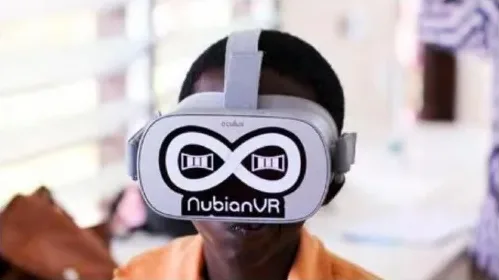
I’m in a couple of groups. In 2020, we ran a hackathon that was supported by Imisi 3D and Facebook, and it helped us connect with other XR creators here in Ghana. This is one of the XR communities we have an association with. There are other VR companies here in Ghana; ReluVR, and my co-founder of NubianVR, Jonathan Dotse, has gone ahead to create Afro Cyberpunk. So that’s a network of XR creators that we are associated with on the continent. Developers and gamers have a lot of groups, and some people have an interest in VR. I think there’s a VR Whatsapp group in Ghana. Nothing formalised, but it’s the best place to start if you want to talk about or understand VR.
Having a community is very important. It makes it easier for people who have similar interests to have a base where they can go crazy and wild. It’s not good to be isolated. What the community does is that it causes a ripple effect so that even the newbies can feel seen and heard. Because of access to the community, there are a lot of people that reach out to us whenever they need help with a project or just building an XR solution. It would have been much harder for the students if they were unable to reach out to us. Being in a formal community also makes it easier for people to update their skills and share ideas. This was why the 2020 hackathon provided good visibility for XR creators. And it’s also good to see organisations like Imisi 3D, whose main work is largely around building this community.
When we were creating our first 360 video, Big World Cinema backed us. During the African Futures Festival in 2015, they created a workshop for creators across the continent to come over to learn how to create VR solutions. That was the first time I got to use the Gear VR. That was also the point where we generated ideas for the workflow for creating content outside of 360 videos. The community is relevant to the growth of the XR industry.
What has been your overall experience getting funding for your projects?
It’s been a multifold experience. Although we were supported by the UNICEF Innovation Fund, most of our projects have been self-funded. Last year, we decided that we were going to change the structure of the company to move it forward. Previously, we were married to the VR space and VR for education, it was a narrow market. For now, VR for education is research-based, and it will take a while before we make profit from it. Research needs to be done to know the health risks. For instance, what are the health risks associated with the prolonged use of VR for young children? You know, some questions need to be answered before we can move forward.
We came up with a different approach to it and set up the Nubian Foundation as an offshoot of NubianVR. So the foundation is committed to education, while NubianVR is an interactive products and games company. Funding the foundation has been a lot easier because we get a lot of support from organisations. As I mentioned, we have the Ministry of Education and UNICEF in Ghana funding interactive technology that could be used for education. They have also expressed interest in supporting VR solutions, but we had to put it to them that it should be research-focused as opposed to having a product at the end of the day. At NubianVR we are on a different path and, this year, we will be launching a digital storybook for kids. This does not mean that our products are education-focused, what we’re pursuing is revenue. So until we get more traction which would open doors for the investments that we need, our projects have just been self-funded.
If you get access to funding, do you have a plan for what you’d like to do with it?
That would be dependent on several things. If the reception we get from the audience meets our expectations when we launch the interactive storybook, the next stage will be to invest in content creation. Our goal is to create and sell catalogues of storybooks and use the revenue to invest in VR solutions. The long-term goal is unlocking the market potential for what we call, Digital Twin. Essentially, Digital Twin is the concept of virtualizing physical spaces. For instance, virtualizing a refinery in an oil plant, or a solar power plant somewhere in the Sahara Desert. This is a tough region to access and sending an engineer over there to do a diagnostic check of the equipment will cost thousands of dollars. If it is possible to have a virtual representation of the plant, can remote diagnostics be done if anything goes wrong? Yeah, this is the space we see ourselves going into, and it will be capital intensive. Our pockets are not deep enough to support the research to start building prototypes.
From your perspective, what can policymakers do to support the XR industry in Africa?
I’ve talked about the high cost of equipment, like shipping headsets from the US. There should be policies that support tax exemptions on XR products. I believe it will provide the most encouraging atmosphere for people in this space. There needs to be an understanding of the value of XR products. Sure, it sounds like rocket science, or very futuristic. However, we have relied on information from the Internet for so long, and I believe we need to create a thriving community of creators that can come up with original ideas. We must not miss the opportunity to innovate in this space. Like it or not, this is computing for the next century. It is what science fiction predicted for as far back as I can remember. So policies that encourage the community would be highly welcomed.
Africans have withstood a lot of turbulence in this space, from acquiring headsets to finding opportunities for their work. Now we should be thinking of creating indigenous solutions. I believe the big tech companies in the industry can come into the market to help teams that are already working on this kind of growth.
Where do you see XR in the future?
In the short term, Facebook’s announcement has brought the whole idea of the Metaverse to the fore. It is a huge encouragement to have lots of talents developing In Africa. Everyone from UI/UX to web and geo developers, I mean they are all extending their skills towards the emergence of ‘The Metaverse’. So the future will see more human capital developing in this space. You can see from the Oculus Quest Christmas sales that more people are investing in the hardware. Next year we can expect that those people investing in the hardware will start to create and experiment.
In the next ten years, from my perspective, a lot more will be happening. VR and XR devices will be cheaper for one. Also, people will start to appreciate it because the experience is more elevated and not like what you have with the computer and smartphone. Information condensation allows us to do much more with VR. So, in ten years, it will be clear that VR is not a fad. Already, a lot of people are complaining about disengagement in online learning and stuff. All that will change when you add the element of presence that VR promises.
Let’s say the richest kid in the fanciest private school in Ghana has the same access to technology as some other kid in a poor region. Content by that time will be well understood, and people will find educational material in VR more enjoyable.
Imagine that, instead of having the teacher standing in front of the classroom with poorly drawn diagrams of the solar system on the board, students will get the chance to take a tour of the solar system. The potential for creating different materials to transform learning speed into an emotional connection is great. But we have to consider a lot of things before we get there, especially for the children. Will they suffer from information overload? What does a safe VR space look like for a ten-year-old child? What kind of content should they be consuming?
We also have to consider the psychological effect on those that will be using the space in the next ten years.
What are the goals and targets of NubianVR in the future you talked about?
I think I have hinted at how it would be for us. We want to build a thriving business in interactive technology, within the next one to three years, then pump the revenue from it to explore more expensive reaches of VR. I mentioned the Digital Twins also. We are highly invested in that space. We also have our concerns about the educational space and how VR content can impact it. We are looking at merging brick and mortar institutions with the virtual space. So on one end, NubianVR is committed to exploring revenue opportunities. While Nubian Foundation, on the other end, prioritises strong educational products or models in the XR space.
Is there anything more you’d like to say about being an XR creator and the XR industry?
For us, we’ve been in this space for a while and it was lonely. We had just a few friends like Imisi 3D and other organisations in this space. To see more people taking it seriously is so encouraging. We are eagerly looking forward to seeing how the technology evolves in the next ten years; in the next 100 years.
As an XR creator in Ghana, it feels a little empowering to be in this space. You know this technology is ammunition anywhere in the world. African creators should try to contribute as much as they know because everybody’s growing and learning. The experts are growing as the industry is growing. An expert may be anybody who has a unique insight into how things can be done even if they have one or two years of experience. The most important thing is that there is a tangible growth of talents from the continent. I look forward to this ecosystem and believe that it will grow.
From the Africa XR Report 2022, pages 192–203. Open the PDF at this interview.