
Creator stories N° 10 / 23
Nigeria
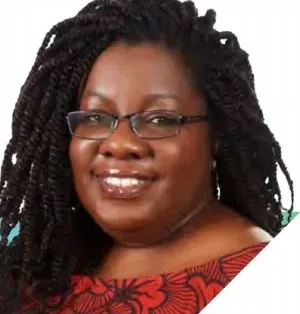
Judith Okonkwo
Founder, Imisi 3D · Founding Director, AR/VR Africa
Judith Okonkwo is an Extended Reality Evangelist, Business Psychologist and Organisation Development Consultant with experience working in Africa, Asia and Europe. She is a member of the World Economic Forum’s Global Future Council for Augmented and Virtual Reality, and sits on the Global Council for the Africa Centres of Excellence for Bioinformatics and Computational Biology. In 2016, she set up Imisi 3D, an Extended Reality creation lab in Lagos focused on building the African ecosystem for Extended Reality technologies (AR/VR/MR) and connecting XR communities across the continent. In 2018, she convened the AR/VR Africa consortium, which holds large XR events on the continent. In this interview, she shares her vision for Africa’s XR Community and Imisi 3D’s role in that future.
What’s your educational background, and how has it led you to what you currently do?
I have degrees in psychology and business psychology. So professionally, I am a business psychologist. I’ve done everything from a stint in the Nigerian military during my youth service, to working in academia, consultancy, aviation and financial services. Lots of varied experience in different fields. I’ve also always had a natural curiosity about the future and a genuine interest in technology and what it can do. I dabbled in a few technology learning opportunities when I was younger, a little bit of learning about databases, and I used to play around with tools like Dreamweaver.
Another interest of mine is leadership on the African continent. Several years ago I developed a leadership development coaching model based on the Oriki of the Yoruba people - an ethnic group found in southwestern Nigeria and portions of West Africa. Later, still living in London and now starting a doctorate, I was doing even more work around leadership in Africa. And I thought, “Well, I should probably spend a bit more time on the continent, if I am really going to do this meaningfully.” So I started checking out different cities. I went to Addis Ababa, Accra, Nairobi, then I came to Lagos. Lagos in 2014, was such an amazing time for innovation and technology, so many incredible people. One of the people I met was the co-founder of Andela, prior to Andela starting. He talked about what he was going to do and it just made absolute sense to me. I was like, “I’m in. I’ll do whatever I can to help”. So I came to Lagos and spent a year helping Andela get started here in Nigeria, and in Kenya.
How did your interest in XR develop?
That foray into the technology startup world with Andela gave life to so many things I believed and had been trying to get people to see, especially during my time in Europe. The fact that this country, this continent, is full of these really incredible, hardworking, talented people, despite all the stereotypes that exist. Around that time, there was also a great buzz around the Oculus acquisition by Facebook, and quite a bit of excitement starting around Virtual Reality, and yes I was just a tad bit excited about that. I really wanted to get the DK Two, but couldn’t. Instead I ended up getting the Samsung Gear VR once it came out. And once I got it and tried it, I was like, “Yes! I can see the possibilities”.
I was so, so excited. And I kept thinking about the talent I’d encountered. These amazing, incredible, hardworking young people who, in my opinion, could literally make magic. They would go to such extraordinary lengths to learn, to develop themselves, to excel. That’s something I really appreciate about people, the commitment to excellence, to doing their very best work. They were changing global perceptions of technology talent, and creating unprecedented demand from Africa.
What a world it would be marrying all of that potential with the potential of this technology which is finally in the consumer space. The more I thought about it, the more I thought it should happen. And the more I thought it should happen, the more I told people about it.
Not a lot of people got it. And let’s be honest there was this great debate going on in tech circles about whether VR was just hype or the next evolution of technology, what the killer use case would be etc. Despite this, one thing I think everybody sort of agreed on, even if they weren’t saying it out loud, was that spatial computing was going to be the computing platform of the future. And for me, that reality meant that this was in some way, shape, or form going to underpin much of our future. And if that was the case, we had to be part of it. So, I started and I thought “Well, if I really believe people here in Nigeria, and other African countries should access these technologies, then I’d better start to make it happen”. So, I began.
It was a simple start, I ordered a VR ready computer from Amazon. I’d already gotten the Gear VR. I got a couple of books and a 360 camera. Bosun Tijani gave our lab its first home, a corner of the legendary 6th floor at CcHub. I’d also bought a carton of KitKat and kept a bowl of chocolate on the desk. I knew that would catch people’s eyes. They would come over and ask, “ Can I have some chocolate?”, I would say yes, and we’d start with chocolate and end with VR. And then the conversations would really start.
What was the vision when you started Imisi 3D?
I wanted us, African voices, to be part of shaping and defining this technology. And I thought, “My God, we certainly don’t want the situation we’ve seen with other technologies.” Like Artificial Intelligence, for example, where there’ll be an incident one day, and people will say, “Oh my goodness. Oh, there’s a bias there. There wasn’t a diverse team working on this, that’s why we have these sorts of problems.” We could eliminate all that going forward if we just set out to make this technology accessible and inclusive.
The vision was that we would adapt and adopt the Extended Reality technologies for our purposes. The other thing I’d seen and I knew was this - the kind of solutions we need locally might not be the first thing on the lists in other parts of the world. So if we wanted them, we had to build them.
So, that was the big picture, that we would be part of that. In practice, it was people having access because it shouldn’t have to be us giving them access. People would have access to the technologies, people would be able to acquire the skills and knowledge to drive work, research, creation with these technologies, and develop expertise. I remember in those early months, someone asking me how I would know if I succeeded. And I said it will be when you’re looking for XR talent in the world and you want the very best, you’re planning where to call and you’re just as likely, or my real vision - even more likely, to call Lagos or Douala or Nairobi as you are to call Singapore or London or Kyiv.
We’ve never been a traditional business, we are wholly impact driven and mission focused. So, I just started on my own.
What are some of the activities Imisi 3D is involved in?
We’ve tried a few things. I always start with our XR labs, which are open access, and free. Anybody can walk in, spend time there, use equipment, and learn. That’s always the first step. And in service of that, particularly before the pandemic, we would focus a lot of our energy and resources on evangelization. Going out into the community in various ways, whether that’s going to large scale events, or to schools, places where we introduce people to the technologies, do demos, and do talks. We did that extensively and had quite a reach. We also have sessions where we’re hosting groups in the lab, particularly students, both secondary and tertiary. They come in to do sessions in the lab, to find out about the technologies and to explore.
We also do some training. We have an introductory course for VR that runs over a couple of weeks which we’ve run in the southern part of Nigeria. We run lots of workshops. We also look for ways to support the community and we have a sub-brand called AR/VR Africa, which is really focused on that work for the community across the continent. Under that remit, we have an AR/VR Africa group on Facebook. Prior to the pandemic we ran in-person meetups every other month, bringing people together to try things out and do workshops and tutorials related to XR. We also organise events to inspire people to build. We’ve been doing XR hackathons since 2016. And with these the intent is twofold: can we get people to build for various sectors or the challenges we have; and how can we demonstrate the impact of the potential of XR for society.
For the first hackathon, we asked participants to create solutions for either education, healthcare or tourism. Sectors with scope for significant positive impact locally. Those verticals have been a recurring theme over the years, and we expanded and added others like climate, social justice, gaming, etc. Our last hackathon in 2020 was the largest by far because of the pandemic. We ended up going from an in-person event planned for 10 countries, to having this hybrid event with participants from 28 African countries.
So, it’s activities like that. We’re constantly thinking, what more can we do? How else can we engage people? We opened mini labs in seven states around Nigeria. We had seen a concentration of activity in Lagos because of what people could access. We look for creative ways to make sure more people can have access to the technology and resources, it’s a key element of our strategy.
Alongside this we definitely build or create, but the amount varies. Building and creating is at the heart of what we do. Our purpose is to facilitate people building and creating with XR. So we’re always encouraging that in some way. Whether it’s through our labs, giving people access to equipment and resources, or encouraging people who come through our doors to develop. For example, we’ve just had some interns from a university spend time with us. And as they go through the learning journey for these technologies, there’s this emphasis - “Okay, every week, let’s see what you can create”, what can you build?
What is the most significant or impactful work that you’ve done?
I don’t think there’s one thing I would pick. We’re doing a lot and hoping it will have an impact beyond what we imagined. There are things we are doing, or have done, that I think could really make a difference. Our production work with Daughters of Chibok and Lagos at Large, for example. It cast a spotlight on XR creative talent from the continent because, of course, everybody was wondering, “who is this person we had never heard of who won the Golden Lion for Best VR story”, and things like that. Kachi is this incredible talent who had been making amazing documentaries for several years before that. But in the immersive media space, people were just realising that they needed to pay attention to him. It was similar with Jumoke Sanwo’s Lagos at large. Bringing this global spotlight to African XR creators is wonderful, and emphasised in this instance by both productions making the Forbes list of The Top 50 XR Experiences of 2019.
There’s our VR for Schools work. I truly believe XR will transform education, particularly in resource-constrained environments. As part of the initiative, we worked with UNICEF to create educational virtual reality content for the Nigerian secondary school curriculum. Lagos is a city in Africa where the population is growing to outstrip the physical resources and infrastructure. We already have challenges when it comes to space, qualified teachers, learning resources and funding, so much so that if we’re looking at conventional means as a way of solving them, we’re not going to get anywhere. If VR for Schools is the beginning of solving that, that will be incredible.
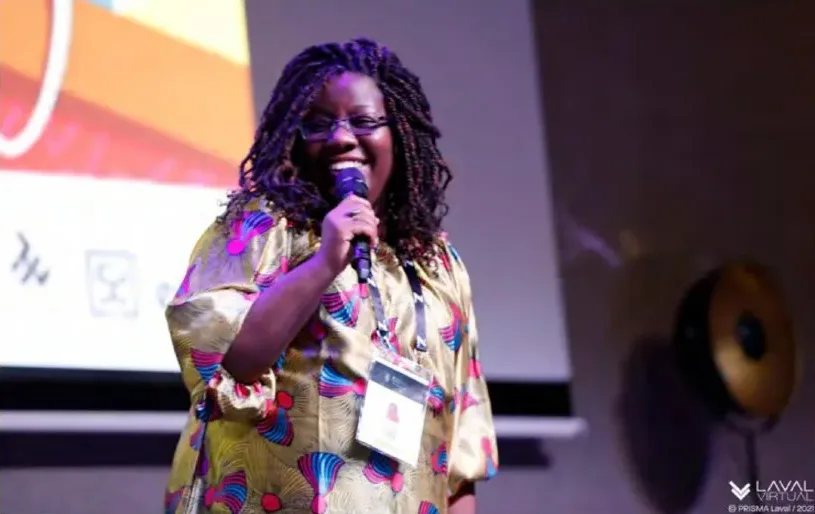
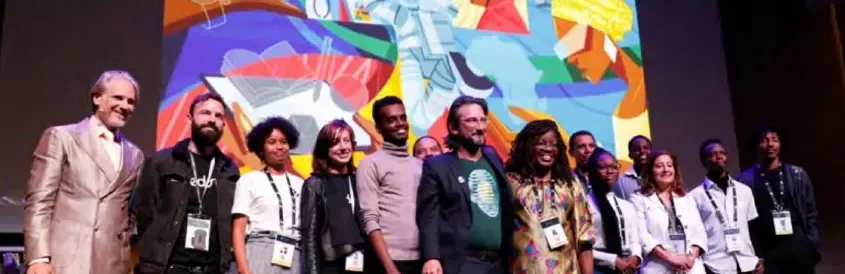
Finally, I will mention the African Delegation to Laval Virtual in 2021. It was something we’d been trying to do for a long time (4 years!). Getting an African delegation to a global XR event, not just to observe, but to fully participate. We had an African Pavilion with 6 startups from different countries showcasing African XR products and services. We were there to do business.
Despite this, I often feel we’re not doing enough. We’re much further behind than I would like and there is so much to be done. We need to get more support, we need to get more people working together, we need to get more countries involved. There is so much to do. So every time our work makes a difference for even one person, perhaps inspires them to start their XR journey, that’s really meaningful.
So, what are some of the challenges you’ve encountered?
Funding has always been a major problem. Africa has been this black hole when it comes to XR. The amounts that trickle in, when you think about it, it’s ridiculous in the larger scheme of things, right? So, there’s that.
For some of the other challenges, we started to talk a bit about talent and opportunities for people to learn. It would be helpful if opportunities to acquire knowledge and skills were more readily available in our formal institutions. That change does need to happen soon.
I think not only do governments need to start understanding what these technologies are, but they need to start thinking about how to create an enabling environment for these technologies in our various countries on the continent.
What do we need to do in terms of our educational systems? What do we need to do in terms of policies? What do we need to do in terms of industry, how do we really incentivize this space, given all these challenges that we know exist? Because if these technologies are what they are, if they’re part of this computing platform of the future, if they are the key to so many solutions that can really make a difference? Then we should be developing this ecosystem a lot more.
How do you find talent?
We have a non-traditional approach because our goal is to get more people involved with XR. So when we can, it’s an open door policy. You want to do XR? Yes. Come and then we will see. Can we support your growth and development, can we help you acquire and apply the knowledge and the skills that will allow you to thrive in this space?
That’s typically how we work, as opposed to looking for specific talent we’re trying to develop the talent. In a lot of situations it might be more expedient, sometimes even cost effective, to get the work done in another part of the world if it was solely about production. Our focus is on being African, so we make sure that we’re building on the continent, with people from the continent, in all the work we do.
Without a bold XR vision for the continent, and stakeholders working together, I fear we will fail. We will fail our young people who are the workforce of the future.
Judith Okonkwo
What keeps you going?
I could say a lot of things like, I’m not a quitter and all of that. But I think even more than that, this work, it’s not something you quit. It’s so much more than me. I believe if we do not do this work, we will have a world in which we can not live in 15 or 20 years. I think a world where Africans have been excluded from the XR technologies is one that is headed towards catastrophe. And when I look at it from that perspective, it is work that must be done. It’s been heartening, in the last two to three years, to see a lot more people coming into the XR space.
More young people doing work on the ground, which is fantastic. Hopefully that will continue to grow because we really do need everybody working together.
What can you say about Africa’s representation in the XR space, and what more can be done to encourage it?
There are people flying the flag for the continent in great ways. Look at the amazing work that Ingrid is doing in South Africa with Electric South, the labs they run, the amazing catalogue of African immersive content they have produced. It has given people in all parts of the world a sense of the talent available locally, which is fantastic.
All the award winning work that we’ve seen emerge is telling its own story about what’s possible. Black Rhino VR in Kenya has been doing fantastic work supporting the community, running initiatives, upskilling people, and advancing the ecosystem there.
One thing I hear constantly is, “Oh, people do XR in Africa? Oh, we didn’t know that. We don’t have any information, how do we get data?” We are bridging that knowledge gap with the Africa XR Report. Not just for the wider world, but for our ecosystem too. It’ll be fantastic to have this resource, if you want to do an XR project in Benin Republic, you can look it up and find out who’s doing XR there and connect with them.
What hardware and software does Imisi 3D use?
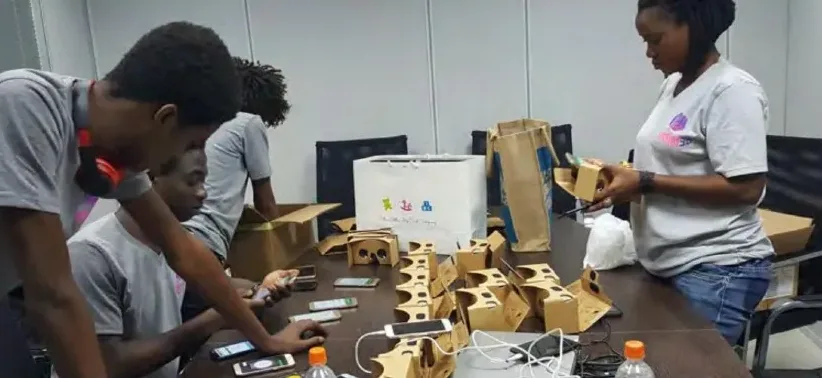
We’ve tended to focus a lot on Unity in terms of software. One thing we’ve always wanted is to have a range of hardware when it comes to XR. We have a lot of Oculus headsets; HTC; and Samsung - the old Gear VRs and the Odyssey. We have 360 cameras like the Ricoh and Samsung 360. For productions, we use the Insta 360 Pro II; and we have other bits and pieces in the lab, like the Leap Motion.
Am I happy with the hardware that we have? No, we want more. Of course, alongside the headsets and devices I was talking about, we’ve got systems, PCs, and laptops that are XR compatible. I’d like to have a super heavy-duty workstation that will allow us to be much more efficient in post-production for our 360 immersive pieces.
We want to have equipment like the HoloLens and the HoloLens 2. We want to have more high-end headsets so people can start to experiment with those and see what’s possible. There’s so much more we should have. And the idea really would be that we have some of everything. The idea is not so much that we’re specialising in one particular aspect of it, it is that this will then be a place where people can come and understand the breadth of what’s possible in the field. You can experience it, you can start to decide in what direction you want to take your own XR journey. Most of the equipment in the lab came in my suitcases, because XR hardware is not available here, it’s not sold locally. I hope that changes soon and the Big Tech companies begin to sell their XR equipment on the continent.
Imisi 3D has a dedicated community on Facebook. What are the activities community-wise? And who are the community players?
I was in the fortunate position to see the impact of tech communities before I started this work. In Nigeria the technology communities have made a huge difference, driving the growth of the ecosystem.
We want to create something similar for XR, where people come together with shared interests to learn and support each other. We want to see more labs in other African countries. The AR/VR Africa Facebook group gave us reach beyond our physical location, and is open to the whole continent. And then we would have these physical events locally, where we’re able to bring people together for the networking and learning experiences that are the hallmark of community events.
What those did, and continue to do, is give people the opportunity to connect. And I’ve seen quite a few examples of people connecting in that space and going on to work together.
Who has supported your work so far?
There is UNICEF, as part of the innovation fund to support the work we were doing with VR for education. The majority of the other financial support has been limited to sponsorship for programs and events we’re doing. Meta, for example, has sponsored all our hackathons so far. Saison Africa 2020 funded the African Delegation to Laval Virtual. There’s in-kind support too, so many have been incredibly generous with their time, expertise and resources; and our lab has been hosted by CcHub and Meta’s former community space in Nigeria, NG Hub.
What are your thoughts on policy? And what are you hoping to see from big tech? How can we engage talent and build the ecosystem on the continent?
Something not being said enough about XR on the continent is the need for an African XR strategy, a continental agenda must exist. We need governments at the national level thinking about and working actively towards this, as well as at the continental level. Because without that, what direction are we going in? We must say we want to achieve x or we want to achieve y. Then we can work backwards from that by putting all the required blocks in place. We also need African access strategies in big tech companies that are informed by Africans. In service of this we need to have a gathering bringing all stakeholders together - government, industry, academia, big tech, practitioners, international organisations - an African XR Summit.
Without a bold XR vision for the continent, and stakeholders working together, I fear we will fail. We will fail our young people who are the workforce of the future. That’s the first thing. The second, and this is addressed more broadly to everyone on the continent, would be that these technologies, whether you like them or not, are part of our future as the human race. So get involved. It might not be directly with the technologies, you could support someone that wants to learn. But one way or the other, know this: It is not coming, it is here. And we need to figure out how we’re going to play.
When it comes to education, how are we ensuring that the learning needed for expertise in these technologies is being introduced into the school system as early as possible? What do we need to do? Apart from programmes and formal institutions, should they exist, what else will support people who want to learn? What kind of things can we make possible as a government? And then what do businesses need if they’re going to be involved with XR?
What are your predictions for the future of XR in Africa in the next year and ten years from now?
In the next one year, I believe we’ll see a proliferation of XR activity. I anticipate a lot of initiatives around XR in the next year that will help people start to understand what direction they may want to explore, what focus areas may or may not be, but I think it’ll be early days yet. There’ll be lots of hits and misses. But, I think it’s all part of growing and that should be good.
Looking out, ten years down the line will be interesting. We’ll definitely see that XR access has increased exponentially and these use cases we’ve discussed will be a lot more established. I see the technologies and the devices, whatever format they are in, then lending themselves more to the way we engage with the world with mobile phones right now. So for example, we’d start to use AR to do ideation work, tasks like that, just because it’s a really exciting visual way to do so.
My hope is that in 10 years, the work we’re doing, trying to build the ecosystem, will be almost obsolete. And that would be because there is an African XR strategy, and that African governments, and other relevant institutions and stakeholders, have put the structures in place to ensure an enabling, incentivised environment for the XR technologies; that there is support for all who want to participate, and there is access.
From the Africa XR Report 2022, pages 180–191. Open the PDF at this interview.