
Creator stories N° 06 / 23
Nigeria
Eugene Ohu
Director - Virtual Human Computer Interaction Lab, Lagos Business School, LBS
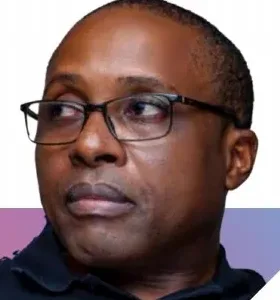
Eugene Ohu is a senior lecturer of Organisational Behaviour at the LBS (Lagos Business School). He established the Virtual Human Computer Interaction Lab at LBS, where he does research in immersive technologies (such as virtual reality) and psychology. In this interview, Eugene talks about how he ventured into XR, his projects, the opportunities and challenges he has encountered, the role of government and big tech in growing XR and what the future portends for XR creators.
Let’s start from the basics, what’s your educational background and how did you get started in XR?
My background may appear confusing to anybody who hears my story because I started off studying Pharmacy, then became interested in computers. I almost quit pharmacy for computers, but I was encouraged to finish and try to combine both. I taught myself programming and began writing computer programs, developing applications, building computers and websites for people etc. I have also worked as a journalist, worked in corporate communication, publishing, SMS aggregation business, and so on.
I later did a postgraduate diploma in education, to prepare me to teach. I have taught as an adjunct faculty in communication at the School of Media and Communication, Pan Atlantic University. I later obtained Masters and Ph.D. degrees in communication, with a focus on the psychology of people and of human relations. In January 2014 I began work as full-time faculty at the Lagos Business School. Within the broad field of Organisational Behaviour I eventually drilled my focus to the research area called human computer interactions which deals with the intersection between technology and the people who use it. I love technology, but I wasn’t only interested in its effect on people, but also how you deploy technology to achieve your goals. And that explains my natural transition into Virtual Reality because in immersive technologies, I found everything I loved about computers. Then in 2018, I decided to take a plunge. I bought the HTC Vive and an Oculus Rift and then realised that no computer at LBS could run it! With help from my employer (LBS), I bought an Alienware laptop, and so began the Virtual Human Computer Interaction Lab!
The first time I used Virtual Reality was in 2017 thanks to my younger brother, who is a professor at Gannon University in Erie, Pennsylvania and runs a VR Lab there. It was an HTC Vive headset and while I don’t remember what application it was, one thing that I came away with was, “This is REAL!.” When I was “inside”, I forgot about my physical surroundings. I don’t remember if he set up a guardian boundary but I remember him telling me, “No, no, no, you’re getting too close to the wall.” It was a truly immersive experience.
After you got access to the XR equipment, what was the first project you worked on?
The first project we did was a clone of Beat Saber. I’m first of all a researcher and I was curious about how you can successfully deploy advertising in Virtual Reality. I know that when people use a particular application or device, they have a primary interest and do not want distractions. If I want to play a game, I don’t want ads or anything to distract me. So, I would rather pay for the game so that there would be no ads.
But considering that some people may not be able to afford a VR game I wanted to study how you could put ads in Virtual Reality such that the player could play the game and get all the goals of the gameplay, and the advertiser who embedded the ads would also achieve their goal.
For my experiment, I needed to create two game conditions, one with ads and one without (in order to compare the distraction effects). Since we didn’t find any VR games with ads, we decided to build our own, a Beat Saber clone.
Which of your projects would you say is the most altruistic?
I think that would be the one we are doing with the Templeton World Charity Foundation (TWCF), a Bahamas-based charity organisation founded by John Templeton. The focus of the TWCF is on fostering character development towards human flourishing.
In 2018/2019 we responded to a call for proposals, proposing to teach empathy and compassion using Virtual Reality. The background to this is the history of Nigeria, a diverse country with multiple ethnic groups. When something negative happens to someone from one ethnic group, those in other ethnic groups might be indifferent at best, or at worst they may feel that the former deserve it. It seemed to us that one thing missing here was lack of empathy. What if you were able to put yourself in the shoes of the other person, you might be able to feel what they feel or share their experience and hopefully you will be more empathetic.
Some have described VR as an empathy machine and we wondered, “Can we use Virtual Reality to put you in the body of someone from another ethnic group such that you will experience discrimination as that person? And when you come out of Virtual Reality into the real world, will you treat the person the same way?” This takes advantage of the perspective-taking properties of Virtual Reality.
So the TWCF project is made up of two studies which involve using Virtual Reality games to teach empathy and compassion. Study one is to see whether a game jam, which involves conceptualising a game, might lead to greater empathy and compassion. While the second one examines how playing a professionally developed game can increase empathy and compassion.
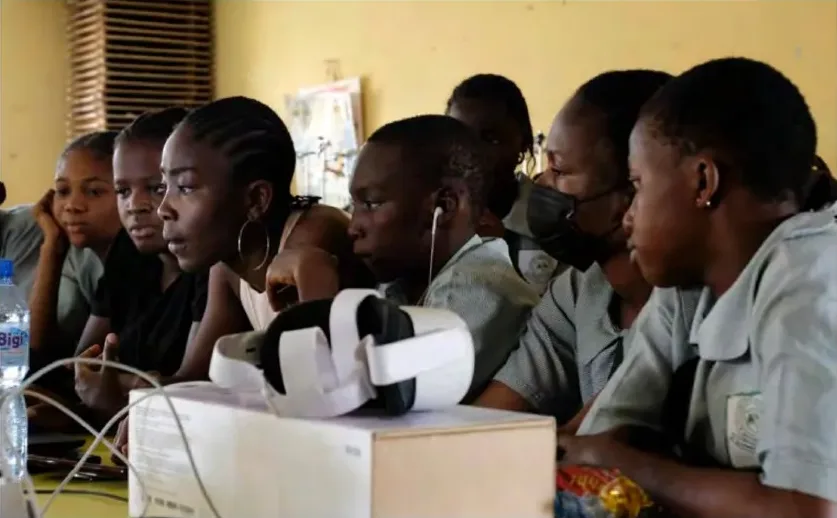
Our study participants are adolescents aged 13 – 18 in SS One and Two (SS – Senior Secondary) of selected schools. For a year now, we’ve been going to secondary schools and having conversations on identity, including ethnic and religious identity, with the students. In the course of this, we helped the students to recognise the uniqueness of their individual identities, their commonalities and differences. These conversations alone have helped them grow in empathy towards other people, and it’s a complete proof of concept that conversations on identity can lead to empathy on ethnic identity. That is one aspect. The second aspect was to get the students to conceptualise a VR game. They built a story where someone suffered ethnic discrimination, they developed a storyboard and, because the time we had was too short to teach them how to create VR games, we had professional developers work with them to build the game based on the script the children wrote. We have completed the game jam and our results show that there was an increase in empathy and compassion.
For the second study that involves a professionally designed VR game, the experience with the students in Study one gave us some ideas, but the children are not partaking in the building. Our ultimate goal is to compare the increase in empathy in the game jam: activities and conversations on identity plus experiencing a VR game prototype, with the second one, using a professionally designed VR game. We expect the latter to be more immersive in terms of sound graphics and other things. We want to compare the empathy and compassion level between the two. In that sense, the first study is serving as a control to the second one.
We’re really in love with this project, because we noticed the participating children growing in empathy and compassion towards people from other ethnic groups.
What equipment - software and hardware - do you use for your work?
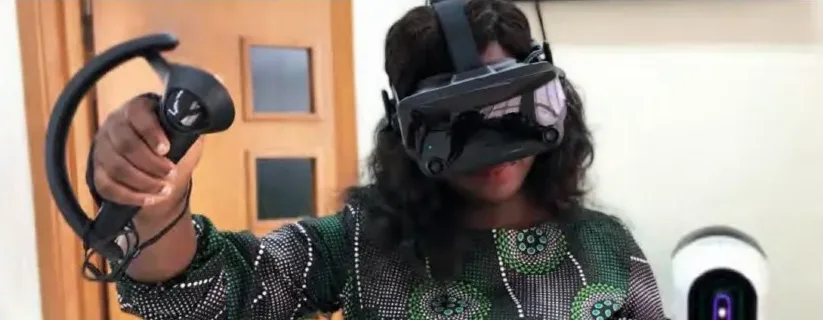
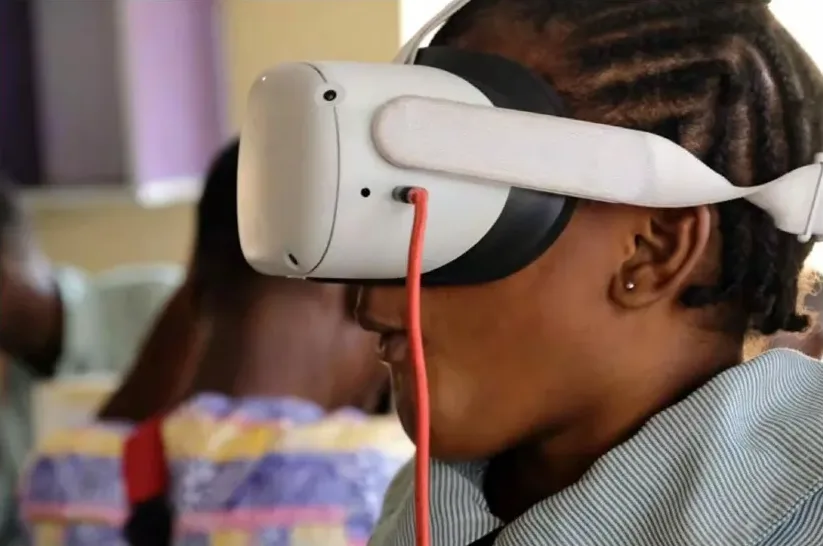
In terms of hardware, we have Oculus Quests, the HTC Vive I mentioned first, Oculus Rift, and then later we got the HTC Vive pro eye with eye tracking, and then the Valve Index. We have 15 Oculus Quest Twos and for computers, we have two Alienware desktops and five Alienware laptops. We also have a Rococo motion capture suit for animation.
For software, we use Blender for 3D modelling. For every other thing we use Reallusion products like 3DXchange. Another software is the Rokoko Studio for animation, within which you can also fix any animation defects. After which you take the animation to iClone and apply the body animation, textures and other features.
We also use an iPhone plugin and another plugin by Reallusion for facial animation. Finally you export the animated character into Unity 3D.
What kind of team do you have now? And in building these projects, how do you get people with the right skill set? Do you do any sort of training?
First of all, there is interest in XR, but there is very little practical knowledge needed to develop things in XR. In that sense, one of the things we found out is that people need real projects. We found people who had experimented with Unity and they knew that VR or AR was the next thing, but they didn’t have any opportunities to try that. And we needed talents in different areas: 2D artists, 3D modellers, and animators.
After some disappointments from people who said they could do one thing but weren’t able to, we decided to organise a 10-week bootcamp with the primary aim of getting talents. The plan was to train people, build talents and get the people we needed.
The bootcamp was based on Unity and was basically self-taught, and self-paced, though we had some people with more experience who joined some sessions to answer questions. There were projects in between with which we could assess the trainees.
The bootcamp is something that I would like to do again, if we have more time, because I believe it will speed up the availability of XR talents for Africa as a whole.
On my team now, we have a Unity developer, a script writer, communication specialists, psychologists, and sociologists. We outsource 3D modelling and we work with a game expert in gamifying our stories.
What has been the biggest challenge you have faced in trying to build XR projects within the African space?
The biggest challenge apart from equipment, which we solved thanks to a grant, is getting talents. If someone with money asks me what they should invest in to grow the XR Community, I would say training.
If we can train people to acquire the right skills and attitude, then give them a project to see from beginning to end, and they will surprise you. That has been my experience with Nigerians. Nigerians are talented, so give them a challenge.
I think what is going to drive XR is content, not technology, and since we have the same technologies they have, very soon all of their stories will become the same, while Africa will bring out richer stories and more diverse experiences for the entire world to benefit from.
Eugene Ohu
Do you believe there is an accurate representation of Africa in the XR space?
With technology, you can leapfrog so that we are all at the same level. The equipment we have here are the same ones the rest of the developed world has. So, even though big tech companies investing in XR have money to employ 1,000 engineers to focus on one thing, and tomorrow they can surprise us with some new products, they don’t have our story! They don’t have African stories. Because I think what is going to drive XR is content, not technology, and since we have the same technologies they have, very soon all of their stories will become the same, while Africa will bring out richer stories and more diverse experiences for the entire world to benefit from.
How have your projects been funded in the past? What will you do with more funding?
My projects have thus far been funded by two sources: my employer the Lagos Business School who bought the first Alienware laptop for me, and the Templeton World Charity Foundation that gave us a grant of $234,000 to equip our lab.
We have applied for more funding which will be used for the other projects we’re working on. One of such is to extend our empathy and compassion research to other parts of Africa and to other age groups. Others are using VR for mental health projects, and deploying dry laboratories in Virtual Reality to secondary and primary schools in Nigeria.
How did you find some of these opportunities you applied for?
Different ways. By presenting our research findings at conferences such as the International Conference for Game Jam and the Games for Change Conference, we get noticed and contacted by grantors.
Not mentioning any names, but there are a number of US grantors looking for people to give research money to and we are in conversation with some of them. The truth is, if you are a grant awarding agency, your reason for existence is zero if you don’t find somebody to give the money to. And if you are looking for such opportunities I will recommend that you should be happy to do good work and take advantage of opportunities to talk about what you’re doing. Attend conferences, disseminate your work.
I can’t praise the Templeton World Charity Foundation enough, because they have given us many openings too. They have given me a different perception of grant awarding agencies, because not only do they give grants, but they actually want you to succeed. They also put you in touch with many people, they tell you about opportunities for other grants to augment what you’re doing.
What kind of regulations or policies do you think would support XR growth in Nigeria?
What kind of support do we need from regulators? None. They should just let the development happen first, because the impression you get from regulators many times is that they try to regulate what they don’t understand. Rather than embracing innovation, they devise ways to frustrate it.
To use an analogy, I usually tell parents that rather than be afraid of technology, tell your child, “Teach me,” “Show me.” I think that’s the attitude that regulators should adopt. Encourage innovation and ask, “How can I support you?” Ask them, “What do you need to make this grow?”
What role should big tech play in growing XR in Africa?
Big tech needs Africa. Africa is unique and Africa will produce its own content. The complete story of the world cannot be told without Africa. There’s a lot about Africa that is yet unexplored and if we allow these stories to come out, they will enrich theories useful to the rest of the world.
I think that for the good of the whole world, Africa should be supported to contribute its content to the global conversation. So big tech needs to support that. For example, they can train more people in XR, invest in developing talents in Africa, knowing that it’s going to enrich the world as well.
Finally, what would XR look like for Africa and globally in the next one year, and in the long term say in 10 years?
One thing that may happen is more African talents in XR would start by doing remote jobs. Because one advantage of remote jobs is that you earn in dollars. And then hopefully, there will be some leftover resources to develop XR here for global consumption.
But I think the safest answer is to say, “I don’t know.” Because they will surprise us. You have Google racing against Microsoft, Apple and Facebook are deploying lots of resources.
I think that the future of VR is going to be in training and collaboration. By training, I bundle all learning and behaviour modifications, simulations and all that, and collaboration with people in different spaces. But I also see the possible amalgamation of VR and AR. I would give an example. We are in this physical space. Let’s say this is the office where we all meet to work every day. There’s a chair and this is your desk where you must sit every day you come to work. And then one day we decide that we should all have a meeting in VR. Staff A is at home, staff B is also at home and I’m the only one here in the lab. So we’re in VR, and we see one another.
But in addition, I would like to see you at your desk. Now we can use AR for that right? To project virtual staff A on this space. It seems crazy but this is one possibility I see. So, VR is very good for learning behaviour modification and collaboration. But I can see a combination of these two.
From the Africa XR Report 2022, pages 150–157. Open the PDF at this interview.