
Creator stories N° 04 / 23
South Africa
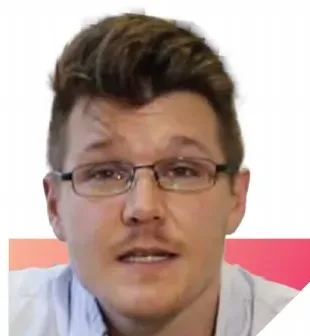
Dale Deacon
VR Artist & Developer, MetaVerseCrew (MVC)
A founding member of weAReVRjozi and the MetaVerseCrew (MVC), worldbuilder and environmental artist Dale P. Deacon runs the TeamEpic.org research and development lab. Dale facilitates the design and development of digital media projects with a focus on immersive media. In this spotlight, he talks to us about his journey into XR, his work as a worldbuilder, and what it takes to be a community builder.
Before building virtual worlds, you were in a different industry, can you tell us how your XR story got started?
I studied Informatics in university and got my career started as a business analyst. As the years went by, I wanted to take my work in a more creative direction, which is when I made the move into the marketing world. I was in marketing for a couple of years when I started to learn more and more about Virtual Reality and Augmented Reality. I remember when the Oculus Rift kickstarter was announced and I really wanted to get on board but I just didn’t have the funds at the time. That really piqued my interest in the technology, and I kept tabs on how things progressed. A while later, the google cardboard came out. I had one of the first VR experiences that really blew my mind. It was a bird simulator game where you would fly from island to island. It was a very simple VR experience because it was on a smartphone, but as a gamer, it was already clear to me how quickly games and computer graphics improve.
I saved up some money and took a big leap. I started my own company focusing on virtual and augmented reality software development. I continue to supplement this work with tech writing, community organizing and educating.
So you had made this decision to move into building for XR, what was the first thing that crossed your mind?
I guess the first question was, “Do I go with Unity or Unreal?”. Obviously, there are other options out there, but those were the two that I was weighing up in my mind. I found that the advantages of using Unity slightly outweighed the advantages of using Unreal. So the first step was to download and play around with Unity.
Then I got back into coding, because when I was working in marketing, I was doing a lot of solution architecture and project management, and not as much coding, as I was in varsity. So I had to get back into scripting. What I’ve realized though, is that Unity and Unreal aren’t all that different. It’s far better to take the time to be proficient with both toolsets than just specialize in one.
Can you tell us about some of the resources that helped you as you got started?
I think most of it was trial and error, trying a particular solution then realizing that it was the wrong route, and then quickly correcting it. When I studied in university I did a lot of coding, which helped, but the vast majority of what I knew about building XR solutions was self-taught. A lot of it was late nights Googling and trying to figure out how to get around a bug.
If I heard about an interesting piece of software or an interesting piece of hardware, I did a bit of research to try and figure out how it could be useful, and if it was worth spending time and money on. If it was, then it became a process of finding out what right resources were to learn more about it.
A lot of it was out of necessity too. Just recently, we worked on a project where the fur on one of our characters just wasn’t holding up on the mobile devices. Our team did a lot of research very quickly to try and figure out what a better route was, and I think that same principle applies to a lot of things we do. You try your best upfront to make a good decision, but sometimes you end up resolving it on the fly.
You work on both AR and VR projects, how do you divide your focus between them and what tools do you use?
I think I probably spend about 55% of my time on VR projects and then about 45% on AR projects.
In VR, I tend to build sort of high spec worlds. They are not exactly intended for the average user. I’m always trying to build the best looking worlds that I possibly can. When it comes to AR, however, you’re very much bound by the hardware constraints of a smartphone, which is nothing compared to a high spec PC. So there’s a small difference in my workflow there.
Starting with software. I use Unity every day, I use Photoshop and Visual Studio Code. I’ve been using iClone, Character Creator and Blender a bit recently, and then more and more this year I’ve been working in Unreal.
With respect to hardware, I have a Samsung Galaxy S 7, an old android phone that I use to test AR projects, and a client is loaning me an iPad Pro for a project. I also have an Oculus Quest 2 and MSI laptop with an RTX 3070.
Tell us how you got started with Team Epic and how the first couple of years were?
When I started Team Epic, one of the first things I did was reach out to different people that were already in the industry making cool things. That helped me understand the industry a bit better and make some good professional connections.
My first few years were spent trying to get jobs and trying to meet some cool clients. It was a tricky process at the beginning, because when you’re starting something new like that, you don’t really have that much of a reputation, so you really have to hustle super hard, and it can be really challenging. I was supplementing whatever downtime I had, doing tech writing jobs, any sort of freelance jobs that would help to keep the bills paid.
Luckily, I met a lot of great people in academia, who were very interested in teaching their students about VR and AR. So I did quite a few guest-lecturing gigs at the University of Johannesburg. They’ve got a really great forward-looking Information Technology Department.
I think there’s a misconception that XR is a field of technology. It’s not. It’s a field of media. So I did a talk in the architecture school, I did a talk at the public relations department. I think it’s a common misconception to think that just because there are wires and screens means that it has something to do with technology. It’s not the technology that matters, what matters is what we do with it.
To go back to your question, I did lots of tech writing, lots of small gigs, lots of indie work, and a little bit of consulting those first couple of years. About halfway through last year, things picked up for me a huge amount. I’m very grateful and very lucky about that. Now I’m still working a lot with academics, building apps, but also getting quite into the Virtual Reality events scene.
What is your ultimate goal with the work you do in XR?
One thing that inspires me about VR is that you can be teleported from one place to somewhere completely different. I think teleporting someone into a more peaceful, serene environment is something that has huge potential
I’ve been working on a Virtual Reality meditation and mindfulness app. I started off building it for Steam and the Vive, but then the Oculus Quest came out, and I realized that the Vive’s days were numbered. So more recently I’ve been working on a Quest 2 standalone version of the same app. The tricky part about development is that it takes a lot of time, testing takes a lot of time. You can’t rush them. So I think, although it’s taken a lot longer than I’ve wanted it to, I’m really looking forward to releasing it.
One last thing, which I think is probably one of the biggest challenges at the moment, is the lack of funding for creators. It’s incredibly difficult to go from like, zero to just starting out. I think well-funded competitions, well-funded hackathons, and well-funded exhibitions of people’s work, go a long way in creating a better artist community, and a better developer community.
Dale Deacon
Tell us about some of the projects you have worked on, and the ones you are most proud of.
I’d start with an Augmented Reality app we built for the Origins Centre at Wits University, which is a museum oriented around discoveries of early humans in Africa. We worked with them to build an Augmented Reality mobile app that works on iOS and Android. It’s called Origins Centre AR, you can check that out in the stores. Probably about 50% of the functionality has to be done at the museum, but the other 50% can be done from home. We worked with the Evolutionary Studies Institute to bring some local South African dinosaurs to life using Augmented Reality.
I have also been involved in quite a few VR festivals. I helped with some of the portal worlds and some of the preview worlds for some of the participants in the Venice Biennale 2021. For example, Felix and Paul Studio did a really innovative International Space Station video 360 film. We helped bring a preview of their film to VR chat for the festival. Similarly, I helped build the Red Sea immersive showcase world, also in VR chat. Recently, I teamed up with the DIFF and the GoEast festival to share work done by Eastern European artists in VR.
You will see a lot of my work is in VRChat. And that’s for a couple of reasons, but mainly because it’s relatively quick to build on, as a lot of the functionality and the features are baked into some of the Prefabs and the SDK. Also, because VRChat handles all of the networking, all of the instance management, all of the servers, as a creator, I don’t have to worry about infrastructure issues that might come up.
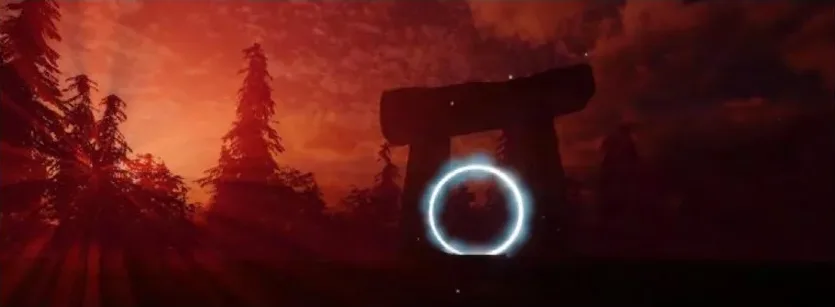
At the Venice Biennale, I had two pieces that were shown there. One was a Virtual Reality forest where you were guided through the experience and you traversed the storyline in a non-linear way. Open-world VR, in a sense. You pick up different chunks of the story and you piece them together yourself.
The other piece was an AI-produced music stream that was displayed in Virtual Reality. So there was a team that built an AI trained on death metal and heavy thrash metal that generates its own songs, thus making this never-ending stream of music. We gave it a home in Virtual Reality, where procedurally generated visuals would sort of rumble and morph along with the music.
The pieces are called the Spirit of Place, and bliss in the ear of the storm respectively. You can find both of those on VRChat.
What are some of the biggest challenges you have faced as an XR creator?
I think in the early days, one of the biggest challenges was trying to build a reputation. Reputation is a challenge for anybody that’s starting out as an independent developer. The only way to solve that is to put out good work.
Another challenge, especially a couple of years ago, would have been just how many people were aware of Virtual Reality and Augmented Reality, what the differences between them were, what they could be used for, and what the advantages and disadvantages were. I think every year, this particular problem shrinks a little. When Pokemon GO came along people started to understand what Augmented Reality could do. Instagram filters came out and now everybody understands what facial filters and that aspect of Augmented Reality could do. I think the understanding of the benefits and pitfalls of these technologies definitely changes and adapts over time. So that’s becoming less and less of an issue.
One last thing, which I think is probably one of the biggest challenges at the moment, is the lack of funding for creators. It’s incredibly difficult to go from like, zero to just starting out. I think well-funded competitions, well-funded hackathons, and well-funded exhibitions of people’s work, go a long way in creating a better artist community, and a better developer community.
The arts aside, there’s also an economic reason to fund this industry. There’s huge potential for new jobs, new careers and new businesses in VR and AR. But we’re not going to see that opportunity taken advantage of until there’s more investment from the public and private sectors.
Being a community builder, do you think there is an accurate representation of the African XR community?
I think that’s a difficult question to answer. Represented where? In the general media? I think in the end, do we want a representative image or do we want to have a proportionate image? The truth is there are probably a lot fewer VR and AR creators in Africa than there are European or Asian or American VR and AR creators. I think what’s important is that we do our best to promote the creators that we do have locally, and help inspire new creators to join the industry. I think the onus is on us to grow the industry, rather than wonder what the level of representation is like.
Following that, can you tell us about some of your personal efforts and activities in the community?
Sure. The Metaverse Crew is a group of people from around the world that get together on Discord once a week to try out different VR technologies and different worlds. We come together to share ideas, tools and techniques. It’s very much an open community to folks who are just generally interested in Virtual Reality. We then go and world-hop through VRChat, Helios, Altspace or wherever together to explore what members have created.
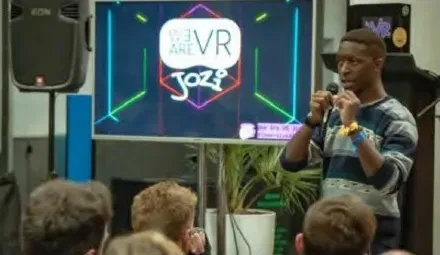
Then more locally, Daliso, I and a bunch of other people from the community have hosted over 20 WeAReVR.jozi events in person showcasing people’s work, projects and their teams. When the pandemic came along, we had to move everything online.
We hosted a bunch of Virtual Reality events along similar lines. Today, we are more focused on our WhatsApp community of sharing opportunities, projects, work, and news.
As event restrictions are starting to wind down a little bit, I think we’ll probably go back to doing in-person events at some point.
Those are my two main community endeavors.
I think it is a strong community we have here on the continent. At the moment, it’s a relatively small group of creators, studios and artists, but I think it’ll grow over time.
It’s very important to have this community. It’s one of the best ways to learn from and meet people who are already doing the thing that you want to learn. For more experienced people, it’s an opportunity to share your work and get feedback from other experts, so it’s a win-win for everyone.
At the beginning of the interview, you mentioned that you self-funded most of your projects, can you tell us a little bit more about that?
Yeah, all of my projects have been funded through working with clients to date, and I’m pretty happy with how that’s gone so far. That said, I wish there were more competitions. I think one of the best ways to fund a lot of new projects is by hosting competitions. This is why the X Prize has been such a big hit for over a decade. With a well-funded prize, you can get a lot of different participants and a lot of different creative ideas trying to solve the same problem.
I think that’s a really effective way to use funding, just in general. I’m very much in favor of hosting and participating in competitions such as the ARVR Africa Hackathon we’ve hosted with community builders from around the continent.
There’s been a large uptick in the use of the word ‘Metaverse’ over the last year. As someone who has been using this word for a while, how have you come to understand it and what concerns do you have about its new popularity?
I think that’s an easy one. A lot of people overcomplicate this idea of the Metaverse, but it’s very simple. The Metaverse is the Internet but in 3D.
You can walk around it, you can walk inside it, you can walk through it, you can have these objects around you. That’s as far as we need to go with a definition of the Metaverse.
I think when people go too far down, like roads, like digital twins and metahumans and all that stuff, they are just introducing more jargon that just puts people off.
You could simulate a training exercise, whether it’s in medicine, or you could simulate training for pilots.
These things have been done for a long time already. There are huge benefits to be wrought.
There are obviously risks involved but I think it’s important that we stay optimistic about the potential for this industry, and not shoot it down before we’ve even had a chance to explore the benefits.
What future do you see for XR and what part do you think you, and Africa, will play in it?
I think in the short term, it’s going to be really interesting to see which companies can produce some sort of an iPhone-like moment for VR and AR. We might already be there now with AR, because we had apps like Instagram, Snapchat, and Pokemon Go. I’m sure in the near future, there are going to be a whole lot more interesting Augmented Reality apps.
It’s very interesting to see how Virtual Reality has progressed quite differently. It may be lagging behind because it requires specialized hardware, and as much as the Oculus Quest has brought Virtual Reality into the lives of a lot of people, I still don’t think we’re really close to mass adoption.
In the long term, I think these two things are going to combine. And that’s why companies like Microsoft don’t talk about VR, and they don’t talk about AR, they talk about Mixed Reality, which is the combination of both of these mediums. I think if you go far enough into the future, you’ll see Augmented Reality and Virtual Reality having much more overlap, and having these kinds of virtual experiences integrated into our real lives, and our real lives integrated more into the virtual world.
Personally, I am very much looking forward to creating more Virtual Reality, mindfulness experiences, breathing techniques and exercises. I’m going to continue to focus on that, and I’m looking forward to seeing how that progresses over the next few years. More broadly, I’m looking forward to seeing how VR and AR are adopted in my own city, to seeing more and more people using it, to seeing more and more creators creating interesting art pieces, statements, apps and applications. That’s very exciting to me.
From the Africa XR Report 2022, pages 134–141. Open the PDF at this interview.